
Washington, May 24, 2026, 11:03 (EDT)
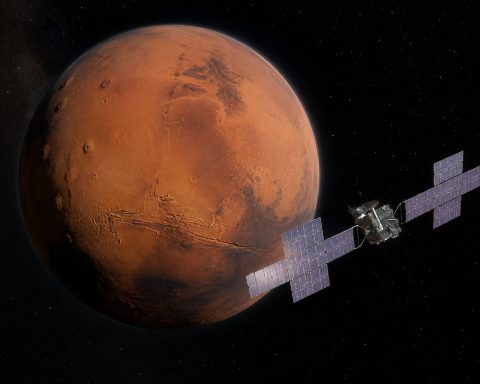
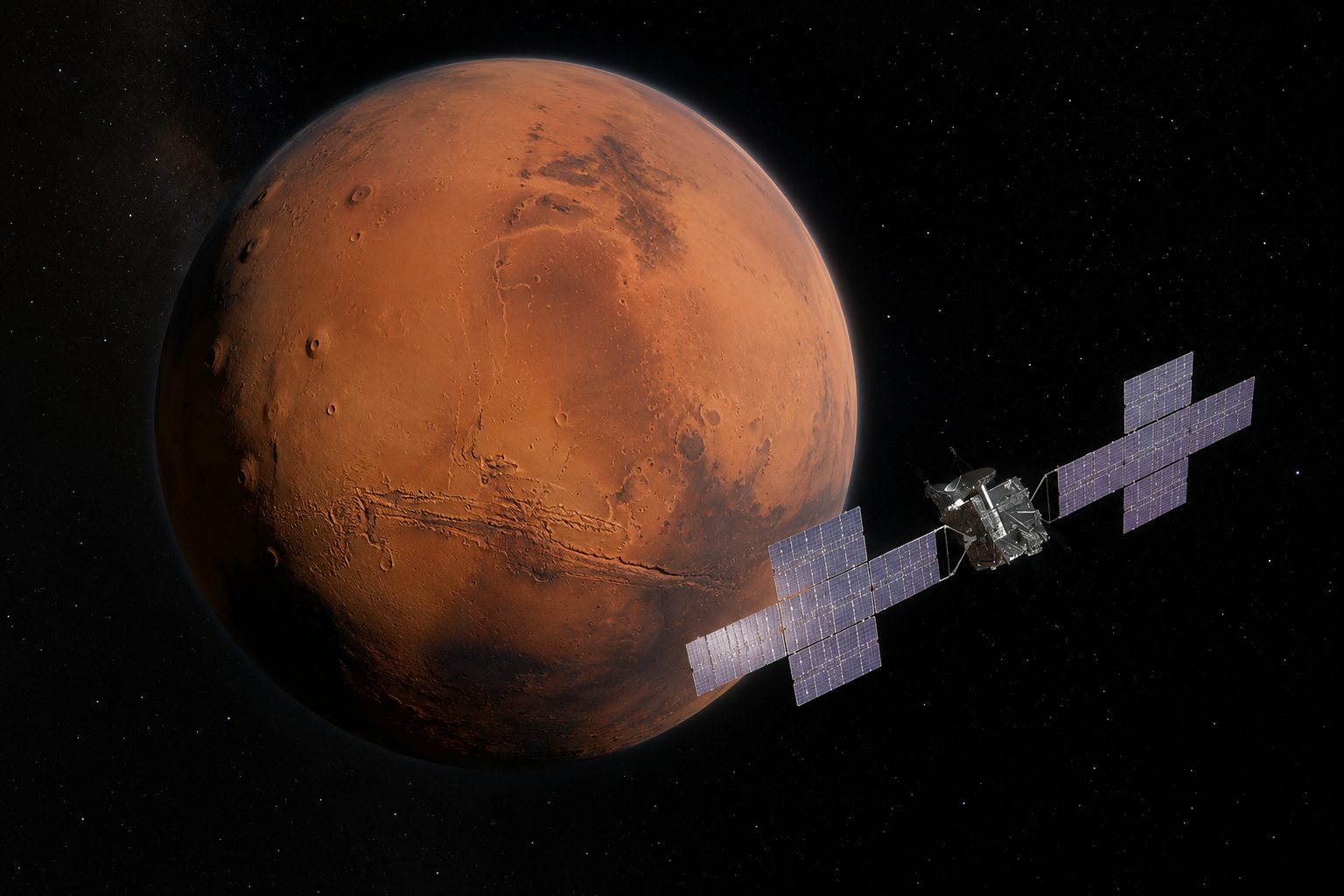
NASA says its Psyche probe remains on track for a 2029 rendezvous with a dense, metal-heavy asteroid, following a close Mars flyby on May 15 that delivered a velocity kick and fresh imagery of the Red Planet. During the maneuver, Psyche skimmed as close as 2,864 miles—4,609 kilometers—from Mars’ surface, according to the agency.
Psyche has now passed its final planetary marker, setting it on a six-year journey toward a unique NASA destination: an asteroid believed to hold substantial metal reserves. That Mars flyby doubled as a shakedown for the spacecraft’s cameras and instruments—tools that will come into play once it enters the asteroid belt.
Psyche’s orbit needed a nudge toward its target, so mission planners turned to a gravity assist — using Mars’ pull to tweak the spacecraft’s speed and trajectory and cut back on propellant. Rather than push solely with Psyche’s solar-electric propulsion system, which runs on sunlight and xenon gas, the team let the Red Planet handle part of the heavy lifting.
Don Han, navigation lead for Psyche at NASA’s Jet Propulsion Laboratory, said tracking data confirmed Mars handed the spacecraft a “1,000 mile-per-hour boost” and set it “on course” for a summer 2029 arrival. After the flyby, mission teams pulled Doppler data—measuring motion via radio-frequency shifts—from NASA’s Deep Space Network to double-check the probe’s trajectory. Space
Psyche’s velocity wasn’t the only thing that changed. As NASA powered up its imagers, magnetometers, and sensors for calibration, the spacecraft managed to snap a shot of Mars—a slim crescent, thanks to its high phase angle. That particular alignment, with the Sun, Mars, and the spacecraft in a straight line, left just a narrow slice of the planet aglow.
Jim Bell, who heads imaging for Psyche at Arizona State University, pointed out that the Mars data brought “unique and important opportunities” to evaluate the cameras and fine-tune the image-processing systems. The team got shots of Mars’ south polar cap, wind streaks near Syrtis Major, and the Huygens double-ring crater. Engadget
NASA credited a handful of current Mars missions—among them Perseverance, the Mars Reconnaissance Orbiter, and ESA’s Mars Express—for supplying comparison data during the flyby. That kind of cross-reference is crucial, since Psyche’s instruments are headed for an asteroid that’s never had a spacecraft pass close before.
The spacecraft lifted off on Oct. 13, 2023, and NASA expects it to reach asteroid Psyche’s gravitational pull in late July 2029. Science operations kick off in August, with the agency planning roughly two years to chart the asteroid and analyze its makeup.
Psyche, the target asteroid, spans roughly 173 miles (280 kilometers) at its widest, and drifts in the main asteroid belt between Mars and Jupiter. Researchers suspect this object could be a leftover core from an early planetesimal—a planet-building remnant—which would offer a rare glimpse at material usually buried inside rocky planets like Earth.
Still, that big question mark remains. Should Psyche prove not to be an exposed ancient core after all, the mission would instead chart a rare, metal-heavy object—just not the tidy planetary-core narrative that’s shaped the mission’s premise from the start.
Lindy Elkins-Tanton, principal investigator for the mission at the University of California, Berkeley, described the Mars flyby as a “critical gravitational slingshot.” With that maneuver behind it, the spacecraft settles in for the long haul—years of steady, low-thrust cruising ahead before it faces its real challenge at the asteroid. Space