
Pasadena, California, June 1, 2026, 14:03 PDT
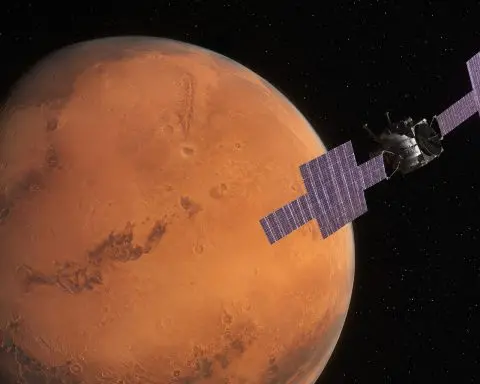
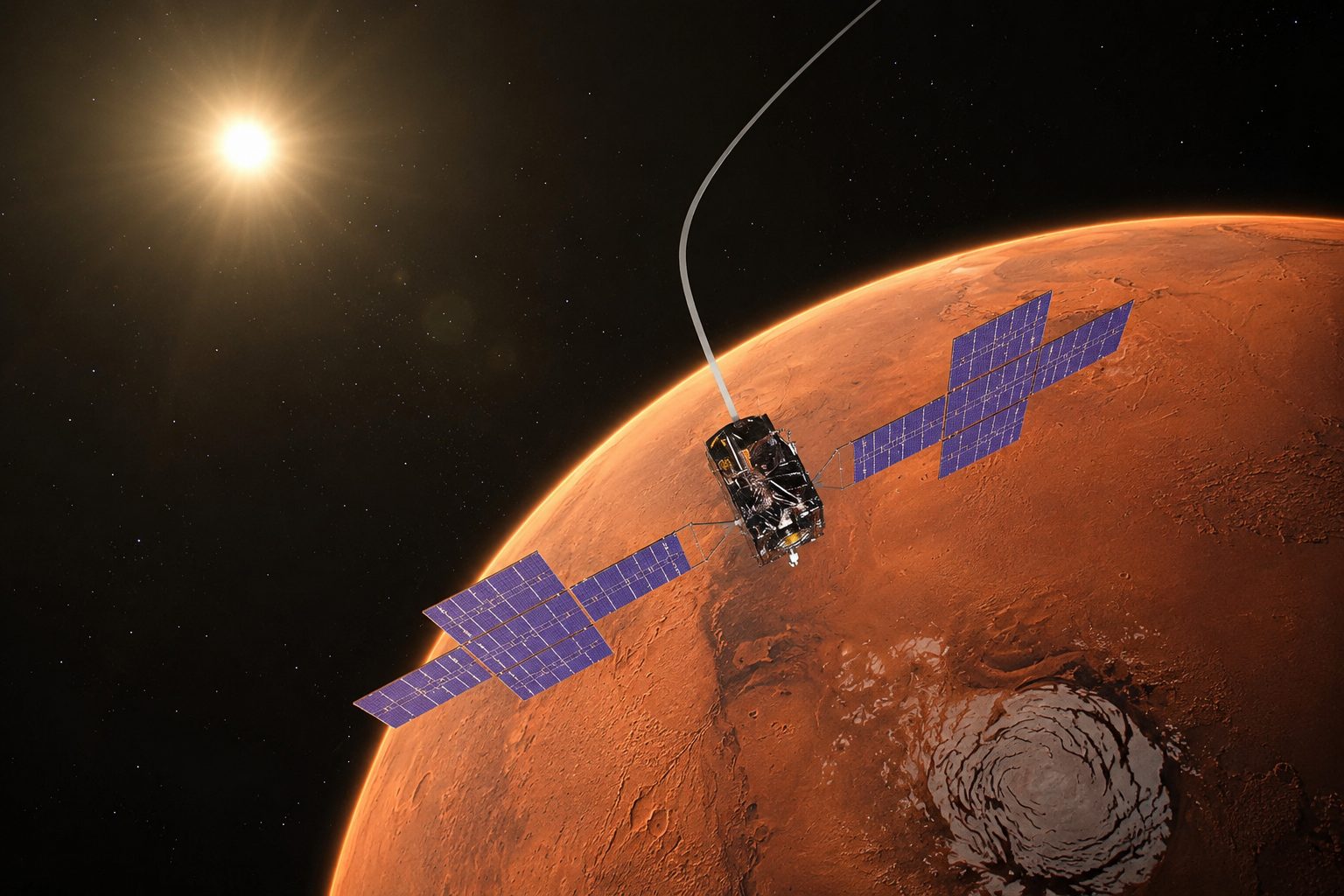
A fresh image release from NASA shows the Psyche spacecraft snapping an enhanced-color shot of Mars’ Huygens Crater, caught after a recent gravity assist that set it on track for its 2029 rendezvous with a metal-heavy asteroid. The photo, taken May 15 just after the probe’s closest approach, captures not only the 470-km-wide double-ring crater but also the rugged southern highlands surrounding it.
This wasn’t merely a photo op: the flyby gave Psyche a crucial gravity boost, shaving off the need for extra fuel. NASA’s Jet Propulsion Laboratory said the spacecraft swung just 2,864 miles above Mars, picking up speed and shifting onto a fresh trajectory toward the main asteroid belt.
The Mars flyby doubled as a dress rehearsal for the mission team. Science instruments came online for the pass, and NASA rovers, along with U.S. and European orbiters, gathered comparative data on the planet’s surface and atmosphere, according to AP.
Psyche’s multispectral imager snapped the Huygens photo, capturing Martian terrain in blue, tan, and purple hues—each color probably tied to variations in dust, sand, or bedrock, according to NASA. Every pixel in the image spans roughly 2,200 feet, or 670 meters.
Don Han, who heads navigation for Psyche at JPL, said Mars handed the spacecraft “a 1,000 mile-per-hour boost” and tweaked its orbital plane about 1 degree compared to the Sun. “We are now on course” for the asteroid, Han added. Sky at Night Magazine
Jim Bell, who heads up imaging for Psyche at Arizona State University, described the Mars shots as a chance to dial in the cameras and tweak the first round of image-processing tools. “Just plain beautiful photos,” he told AP, talking about the images. AP News
Psyche should arrive at its namesake asteroid in late July or August 2029, where it’s scheduled to orbit for roughly two years—mapping, collecting data on surface makeup, gravity, and more. NASA, which launched the craft back in October 2023, is sending it to probe a metal-heavy object that sits between Mars and Jupiter.
Still, the images haven’t resolved the big science question at the heart of the mission. NASA’s official science plan notes that Psyche needs to figure out if the asteroid is actually a planetary core or just unmelted rock. The notion of a metal core isn’t confirmed yet—it’s something the team still needs to test.
The mission faces plenty of competition in the race to explore small bodies. NASA’s Lucy is currently making flybys of both main-belt and Trojan asteroids. OSIRIS-REx, now rebranded as OSIRIS-APEX, is en route to Apophis. ESA’s Hera, for its part, is following up the DART impact test with a trip to the Didymos-Dimorphos system. What sets Psyche apart: it targets a uniquely metal-rich asteroid, rather than the more familiar rocky, primitive, or planetary-defense bodies.
Reuters was first to note the van-sized probe’s 2.2 billion-mile trek, with the Mars flyby slingshot deliberately mapped out to save xenon propellant for its solar-electric ion engines. The mission’s ultimate goal: if the spacecraft survives the trip, it’ll deliver the first close orbital views of a type of world never before explored up close by a spacecraft.