
LOS ANGELES, June 2, 2026, 03:02 PDT
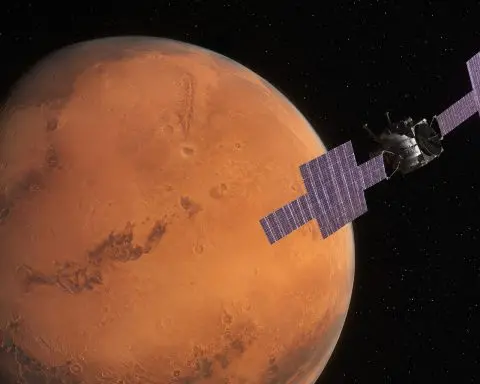
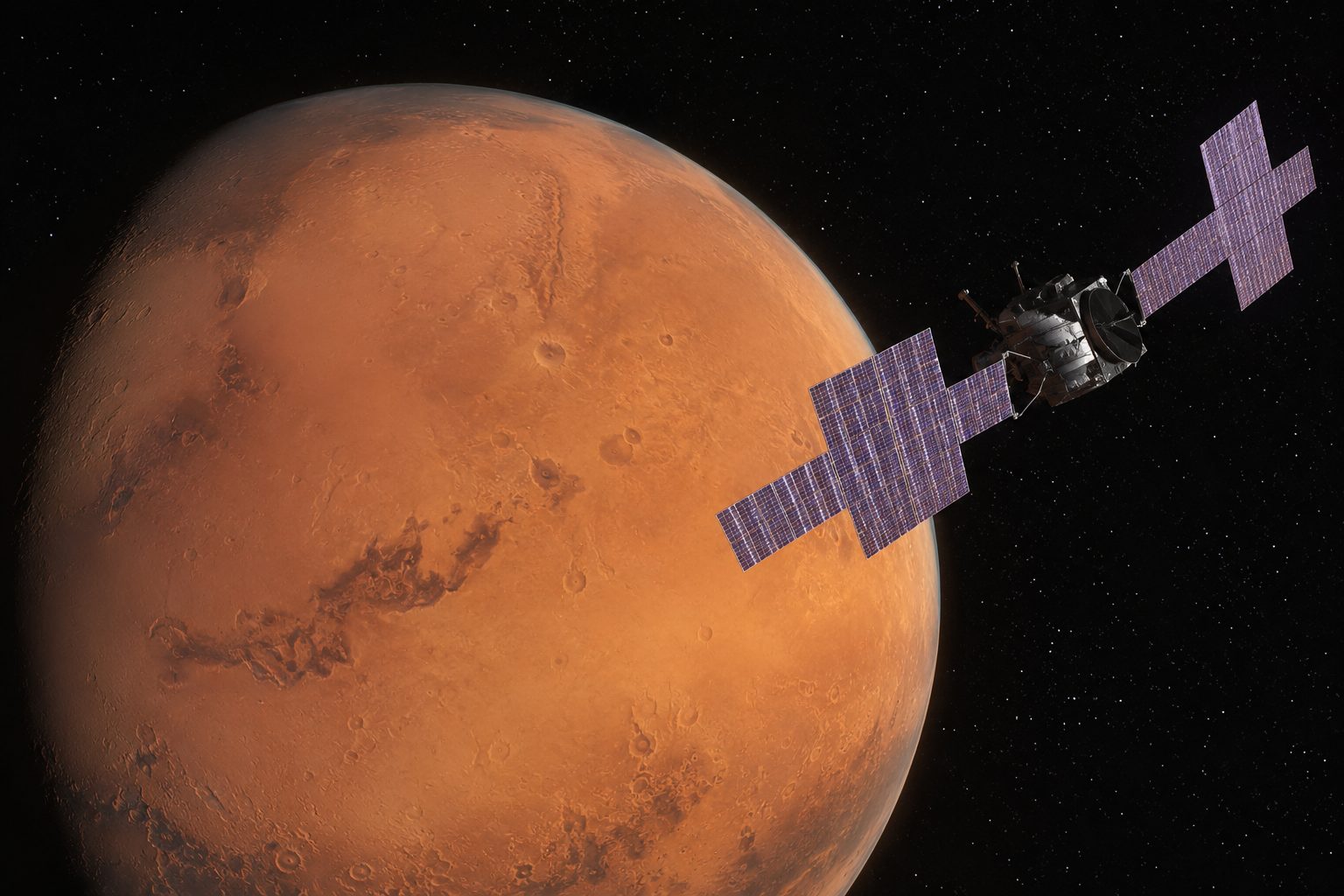
NASA says its Psyche spacecraft is now set for a 2029 meeting with a metal-heavy asteroid, after slingshotting past Mars on May 15. That flyby delivered a 1,000 mile-per-hour speed bump, nudged the trajectory by about one degree, and cost the spacecraft zero propellant. Closest approach: 2,864 miles above the Martian surface.
Psyche is now past the final big planetary waypoint on its nearly 2.2 billion-mile journey to the asteroid belt. The team relied on a gravity assist, using Mars to tweak Psyche’s speed and trajectory—crucial for saving xenon gas that powers the probe’s solar-electric drive.
This was a test run, too. Psyche switched on its cameras, as well as the magnetometers and the gamma-ray and neutron spectrometer—gear that’ll eventually map the asteroid’s surface, magnetic field and makeup. After the flyby, NASA’s Deep Space Network—its global array for communicating with deep-space probes—monitored Psyche’s radio signals to verify it stayed on course.
Don Han, who handles navigation for Psyche at NASA’s Jet Propulsion Laboratory in Southern California, said the craft remains “on course” for its scheduled asteroid rendezvous in summer 2029. After swinging by Mars, the team verified the trajectory by analyzing the Doppler shift—a subtle radio frequency shift that tracks spacecraft movement. Smithsonian Magazine
Thousands of Mars photos came out of the flyby, starting with a slim crescent shot as the spacecraft drew near and then a broad disk snapped after it passed closest to the planet. Jim Bell, who leads the imaging team at Arizona State University, described the haul as “unique and important,” a fresh trove for calibrating the camera and kicking off the first rounds of image processing. Gizmodo
The set featured Mars’ south polar cap loaded with water ice, wind streaks curling by Syrtis Major craters, plus an enhanced-color shot of Huygens—a double-ring crater measuring some 290 miles across. According to NASA, those color shifts seen at Huygens probably show off contrasts in dust, sand and bedrock across the old landscape.
The drill included other Mars hardware. NASA’s Perseverance and Curiosity rovers, plus the Mars Reconnaissance Orbiter, joined European spacecraft on the roster—each offering up surface, atmospheric, or navigation data to compare with what Psyche turned up.
Psyche’s destination: an asteroid roughly 173 miles across at its widest, parked in the main asteroid belt between Mars and Jupiter. Scientists suspect this could be a fragment of a planetesimal—an early planetary core—after surface layers peeled off, exposing dense, metal-rich interior.
That’s the appeal here. Direct samples from Earth’s metallic core aren’t possible, and according to NASA, Psyche marks the first mission specifically aimed at investigating an asteroid with a surface rich in metal—not just rock or ice.
Still, there’s no guarantee on the scientific return. The asteroid could turn out to be something other than a stripped core, and researchers won’t get a good look until the probe delivers those close-up shots. The big hurdle comes with orbital insertion and the survey mission slated for 2029.
Now that Mars is in the rearview, Psyche is set to fire up its solar-electric engines for the deep-space push ahead. Lindy Elkins-Tanton, principal investigator at the University of California, Berkeley, called the Mars encounter a “critical gravitational slingshot.” If calculations don’t budge, the spacecraft’s next destination is asteroid Psyche. NASA