
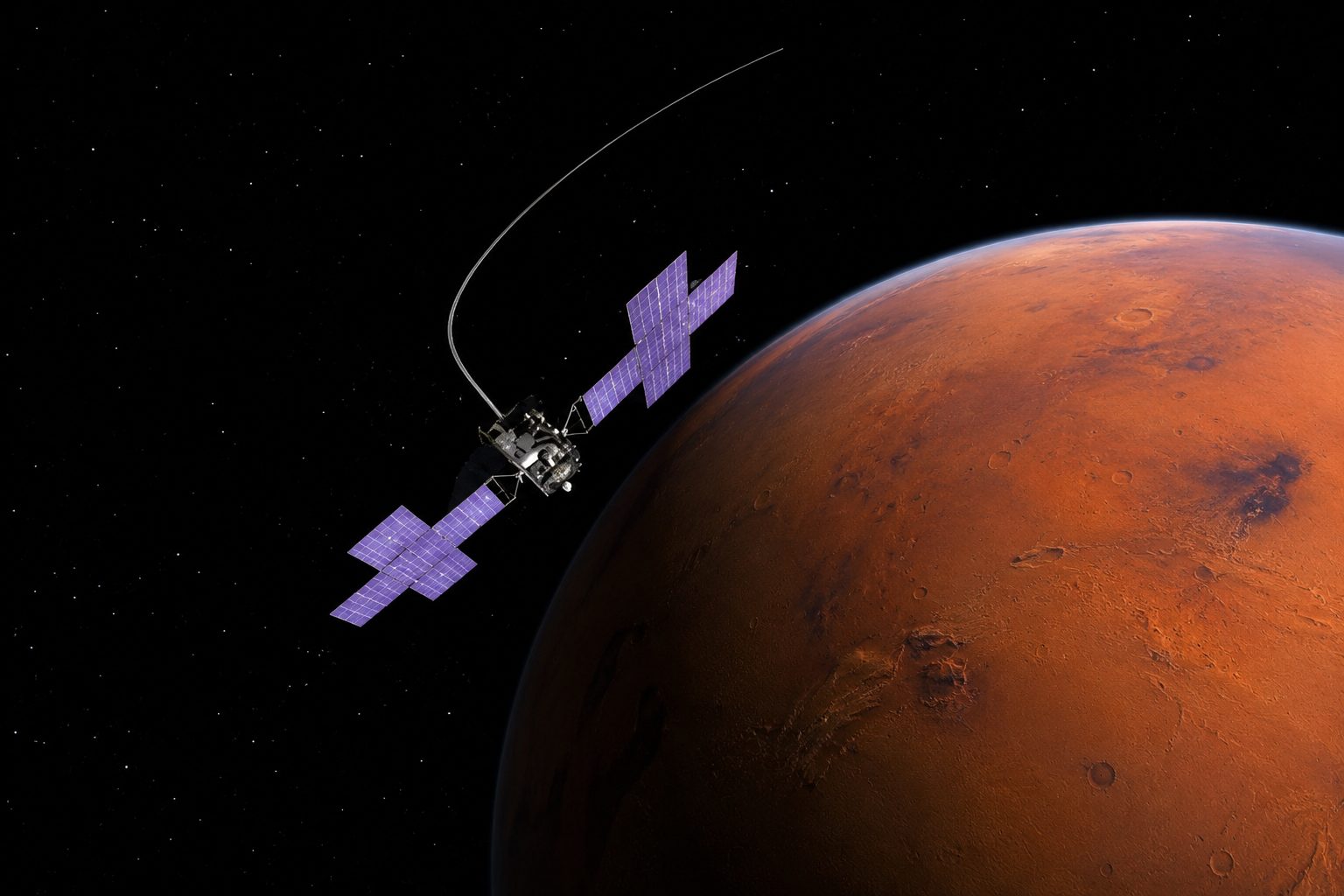
PASADENA, California, June 7, 2026, 08:01 PDT
- NASA reports the Psyche spacecraft picked up speed and shifted its trajectory after a Mars flyby, keeping it on track for its 2029 rendezvous with the asteroid.
- The flyby wasn’t just about trajectory—mission teams used the opportunity to run system checks, grabbing Mars imagery and calibration data from cameras and instruments ahead of the main asteroid rendezvous.
- Engineers had to switch to a backup propellant line after a fuel-pressure problem hit in 2025, leaving the mission with a lengthy propulsion leg still to go.
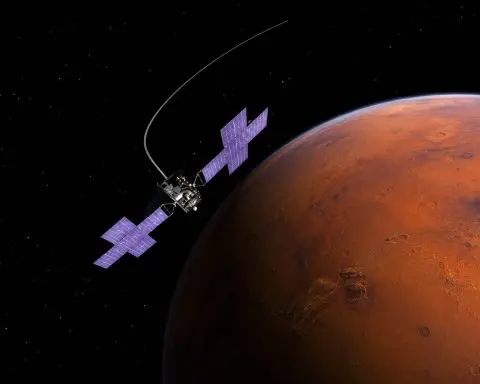
NASA’s Psyche probe has swung past Mars, picking up a 1,000 mph velocity boost from the planet as it heads for a rendezvous with a metal-rich asteroid in 2029, according to the Jet Propulsion Laboratory. The May 15 flyby brought Psyche just 2,864 miles (4,609 km) above Mars, nudging its orbital path by about 1 degree.
This wasn’t just a detour. The flyby was a key part of the nearly six-year journey, cutting xenon propellant use and steering the spacecraft for a direct shot at asteroid Psyche. The target: a chunk in the main asteroid belt, parked between Mars and Jupiter, that researchers suspect could be a remnant from a primordial planetesimal — one of the solar system’s ancient building blocks.
The gravity assist—using a planet’s pull to tweak a spacecraft’s speed or trajectory without burning much fuel—also gave NASA teams a valuable rehearsal. Engineers ran the cameras, magnetometers, and the gamma-ray and neutron spectrometer through their paces ahead of the probe’s arrival at a never-before-visited destination.
Don Han, who heads navigation for Psyche at JPL, said that radio tracking via NASA’s Deep Space Network verified the burn—confirming the spacecraft is “on course for arrival at the asteroid Psyche in summer 2029.” The Doppler shift he mentioned reflects changes in radio frequency, revealing the speed of the spacecraft as it moves away from or toward Earth. NASA Jet Propulsion Laboratory (JPL)
The multispectral imager on the spacecraft—a camera rig using filters to pick up different colors and wavelengths—caught Mars first as a slim crescent, then as a brighter, more complete disk after swinging by at its closest. Jim Bell, who leads the imager team at Arizona State University, described the collected images as “unique and important opportunities” both for checking how the camera performed and for running image-processing tests. NASA Jet Propulsion Laboratory (JPL)
These weren’t just pretty shots for the public. In one release, NASA shared an enhanced-color view of Huygens—a sprawling double-ring crater stretching 290 miles (470 kilometers) wide—designed to highlight contrasts in dust, sand, and bedrock. That image was snapped just after the closest flyby on May 15.
One more natural-color snapshot turned up wind streaks fanning out from craters in Syrtis Major—some lines ran nearly 30 miles. For the team, that meant a baseline: a familiar patch of Martian terrain to measure the camera’s performance as it zipped past.
The third image zeroed in on Mars’ south polar cap, where water ice dominates, delivering resolution down to roughly 0.7 miles per pixel. NASA puts the cap’s width at over 430 miles—making it an ideal, sharply defined target for Psyche’s instrument checks ahead of the mission’s asteroid segment.
NASA pointed to several other Mars missions as key to building the reference frame. Imaging and navigation data came in from the Mars Reconnaissance Orbiter, Mars Odyssey, and ESA’s ExoMars Trace Gas Orbiter—each delivering comparison points for the project.
Still, it’s hardly a smooth ride ahead. After engineers switched to a backup propellant line in 2025 due to sinking fuel pressure, Psyche is set to depend on solar-electric propulsion for the long haul—ion thrusters running on xenon gas and powered by solar panels. NASA has since reported that the thrusters are back to full operations and the system’s working as planned.
Uncertainty hangs over the scientific outcome as well. Psyche measures roughly 173 miles across at its widest, and while there’s speculation it holds a trove of metal, its actual makeup remains a mystery until the spacecraft conducts orbital mapping. NASA notes that, if this really is an exposed ancient core, the mission might reveal material akin to what’s found deep inside rocky planets like Earth.
Arizona State University heads up the mission, while JPL takes charge of mission management, systems engineering, and running the operations. Psyche got off the ground in October 2023, joining NASA’s lower-cost Discovery Program as its 14th entry.