
GREENBELT, Maryland, June 3, 2026, 10:02 (EDT)
- NASA’s Black Marble maps reveal a global uptick in night-time brightness from 2014 through 2022, though some broad areas actually saw the lights fade.
- Why does the data matter? Night lights can highlight everything from city expansion and energy strain to conflict damage, gas flares, and blackouts—spotted from space.
- Asia delivered some of the sharpest gains, while portions of Europe, Venezuela, and regions affected by conflict lost ground.
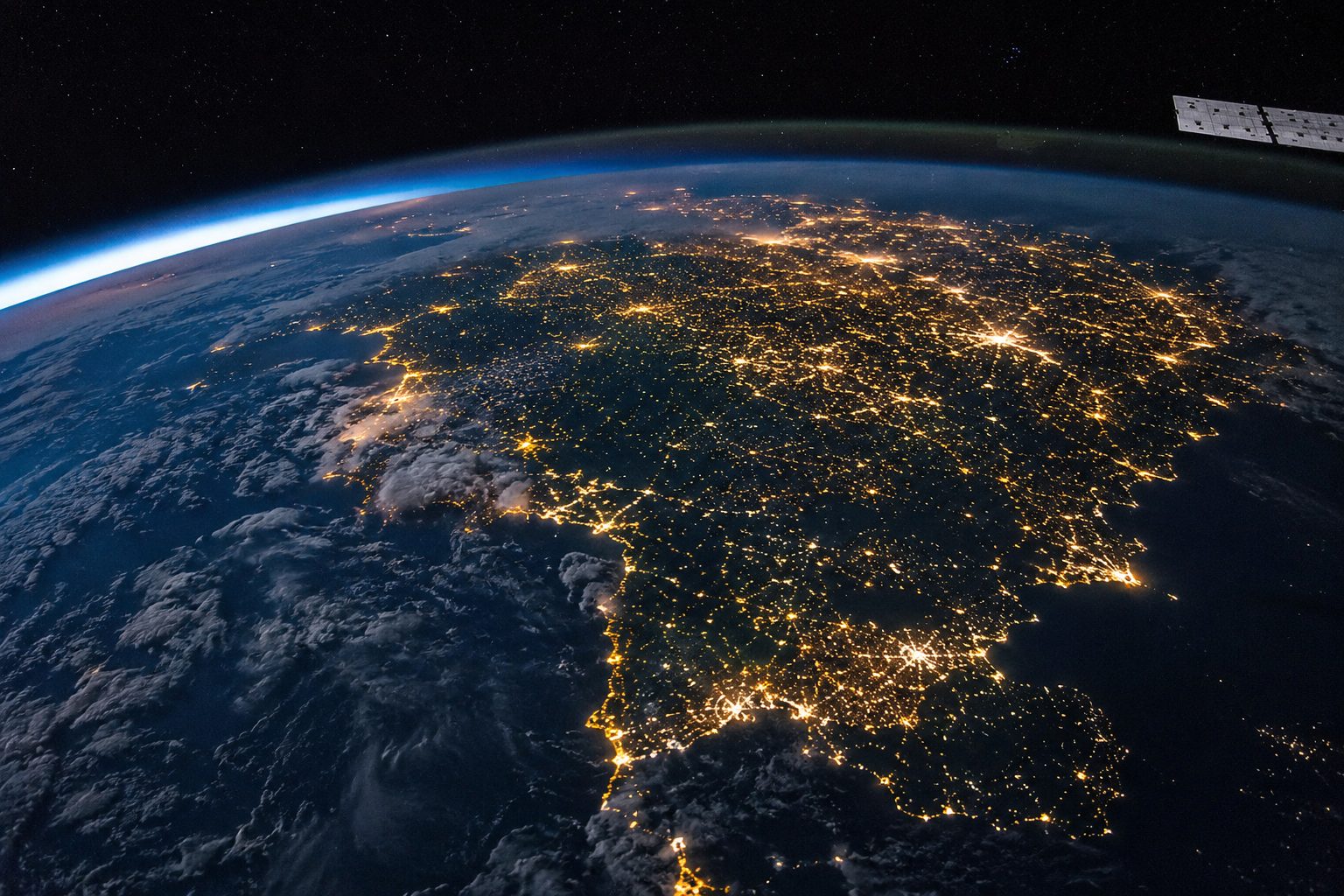
NASA satellite maps have upended the straightforward notion that Earth’s nights are steadily brightening. The illumination isn’t uniform, and not every glow points to development.
NASA’s Black Marble night-light satellite images tell a mixed story: from 2014 to 2022, night skies lit up across much of Asia and Africa, while sections of Europe, the eastern U.S., and countries in crisis lost brightness. According to NASA Earth Observatory, recent analysis marks brighter areas in gold and dimmer spots in purple on their maps.
This matters: night light acts as a kind of proxy for tracking human activity. You can see city growth, spot grid failures, pinpoint oil fields burning off gas, or notice where war or economic breakdown knocks out power. NASA Earthdata notes its Black Marble products give daily, monthly, and yearly snapshots, and see use in everything from measuring light pollution and illegal fishing to mapping gas flaring or monitoring troubled regions.
Published in Nature on April 8, the study reported a 34% increase in brightness compared to the 2014 global baseline, with dimming of 18% taking some of the edge off. The net result: a 16% rise. Here, “radiance” refers to brightness picked up by the satellite sensor. DOI
Tian Li and Zhe Zhu at the University of Connecticut headed up the project, joined by colleagues from NASA and several other organizations. By analyzing daily night-time satellite images and applying a continuous change-detection approach, the researchers tracked shifts in artificial light at night—ALAN, as it’s known in scientific circles.
NASA reported that its team reviewed 1.16 million satellite images snapped around 1:30 a.m. local time by the Visible Infrared Imaging Radiometer Suite (VIIRS) aboard the Suomi-NPP, NOAA-20, and NOAA-21 satellites. From orbit, these instruments pick up even dim low-light signals. Black Marble processing then strips away noise—moonlight, clouds, atmospheric interference—leaving the data clearer.
Most of the rise came from Asia. According to the Nature paper, China and India saw the biggest jumps, driven by urban growth, industrial expansion, rural electrification, and more street lights. Sub-Saharan Africa wasn’t far behind, reflecting fresh power and lighting in regions that had previously stayed dim.
Europe bucked the trend. Researchers measured a 4% overall dip in artificial light radiance across the continent. France saw the steepest drop at 33%, while the UK fell 22% and the Netherlands 21%. The study credits LED rollouts, tighter light-pollution regulations, and energy-saving mandates for the shift.
The U.S. picture was mixed. NASA flagged that West Coast cities lit up more as populations pushed higher, but a lot of the East Coast actually got dimmer—a trend the team tied to LEDs catching on and broader shifts in the economy. Satellites also captured the up-and-down rhythm of gas flaring in Texas’s Permian Basin and North Dakota’s Bakken Formation, with oil wells burning off extra gas.
“Flared gas is money burned,” said Deborah Gordon, a methane specialist at the Rocky Mountain Institute who didn’t take part in the study, speaking to NASA. The data isn’t just about science, according to Miguel Román, who oversees atmospheres and data systems at NASA Goddard; he pointed to potential national-security value, adding, “Earth at night has so much to teach us.” NASA Science
Here, the competition is in the data. Previous night-light datasets—like the Defense Meteorological Satellite Program’s Operational Linescan System and annual VIIRS composites—made it possible to chart urban expansion and track changes in light pollution. But, according to the Nature paper, daily images can reveal swift changes that get lost when you’re only looking at annual statistics.
Dimming skies don’t always signal progress. Sometimes it’s efficient lighting and slashed energy use; other times, it’s wrecked grids, economic strain, even war. The researchers pointed to Venezuela—its drop in brightness wasn’t about saving electricity, but a deeper systemic breakdown.
Zhu described the daily record to UConn Today as a way for researchers to watch shocks unfold in real time, dubbing the patterns “the heartbeat of society.” These maps aren’t just pretty images of a glowing Earth at night—they’re a live accounting of where people construct, conserve energy, experience outages, wage wars, and bounce back. Uconn