
New York, May 25, 2026, 18:03 EDT
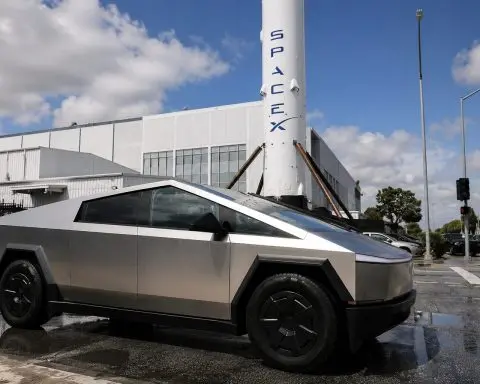
Investor attention is shifting to Boeing’s space and defense units as talk swirls about Elon Musk possibly merging Tesla and SpaceX. That would mean a much better-capitalized Musk company inching toward some of Boeing’s more critical business lines. So far, there’s been no official deal.
The timing here is key: SpaceX’s anticipated IPO has shifted from Wall Street speculation to an active story in the capital markets. On Monday, the Financial Times revealed details from the company’s prospectus, including large outlays, significant plans for artificial intelligence—software designed to mimic human reasoning—and a setup that would cement Musk’s dominant voting power.
Boeing’s turnaround remains bumpy as the debate unfolds. First-quarter numbers: $22.2 billion in revenue, a core loss at 20 cents per share, negative free cash flow at $1.5 billion—cash out the door after capital spending. The backlog? A record $695 billion in undelivered orders to close the quarter. CEO Kelly Ortberg called it a “strong start to the year,” but underlined both “safety and quality.” Boeing Investors
An article from 24/7 Wall St., picked up by Yahoo Finance, casts Boeing as the biggest potential loser in a hypothetical Tesla-SpaceX merger. The piece highlights direct competition across crew capsules, satellites, launch services, and national-security launches. Boeing’s 50% ownership in United Launch Alliance, alongside Lockheed Martin, is also called out.
Right now, the spotlight’s on space rather than on jetliners. NASA recently confirmed that it’s still reviewing launch windows for Boeing’s uncrewed Starliner-1 cargo mission. Work continues on the technical snags uncovered during the 2024 crew flight test, so no final decision yet.
SpaceX is pushing its IPO narrative with a focus on reusable rockets, Starlink, and artificial intelligence. Starlink pulled in $1.19 billion in operating profit for the first quarter, according to Reuters, but the AI division dragged on results, losing $2.47 billion. That left SpaceX with a $1.94 billion operating loss on $4.69 billion in revenue.
The race is moving fast. Last year, SpaceX, ULA, and Blue Origin secured $13.5 billion in Pentagon launch contracts, Reuters noted—SpaceX landed 28 missions, ULA took 19, and Blue Origin got seven. That leaves Boeing facing a market now defined by reusable rockets and tighter launch costs.
Dan Ives at Wedbush Securities is taking the Tesla-SpaceX speculation to another level. He’s calling for a full-on merger of the two companies by 2027, according to Business Insider. Ives also said Musk aims to “own and control more of the AI ecosystem.” Business Insider
Boeing’s 737 and 787 lines aren’t facing an immediate threat from a merged Tesla-SpaceX. Still, there’s a bigger question hanging out there: Could Musk pull together Tesla’s manufacturing chops, its battery tech, and AI crew with SpaceX’s launch know-how and satellite assets to go after government contracts, robotics, space infrastructure, or even the next generation of defense projects?
Boeing hangs on to some tough-to-match strengths: that massive commercial order backlog, deeply rooted defense deals, a steady stream of service income, plus years of certification know-how. For the first quarter, its Defense, Space & Security division turned in $7.6 billion in revenue and managed a 3.1% operating margin. Boeing also reported the segment’s backlog hit a record $86 billion.
Merger talks could easily hit a wall. Recent SpaceX filings have flagged mounting losses, shaky tech, and questions about governance. “There is somewhat of a halo effect around Musk and his unconventional vision,” Georgetown finance professor Reena Aggarwal told Reuters. Valuing firms like this? Tough, she said, since “there is no peer group for comparison.” Reuters
With U.S. markets shut for Memorial Day on Monday, investors have to hold off until Tuesday for the next moves in Boeing and Tesla. Boeing closed out Friday at $219.02, and Tesla at $426.01. Both the NYSE and Nasdaq show May 25, 2026, as another market holiday.