
Pasadena, California, May 21, 2026, 08:01 PDT
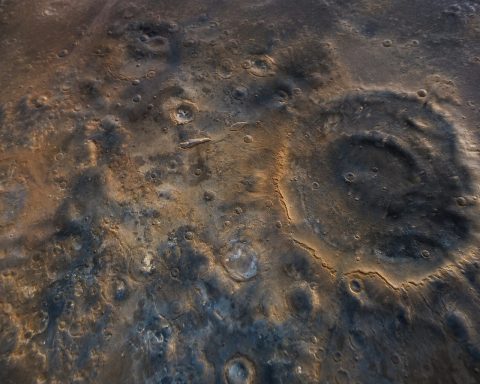
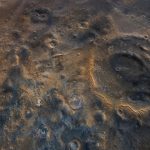
Psyche, NASA’s probe headed for an asteroid, snapped an enhanced-color shot of Mars’ Huygens Crater as it swung past the Red Planet—an image just released by the agency following the craft’s course-setting flyby for its 2029 asteroid rendezvous.
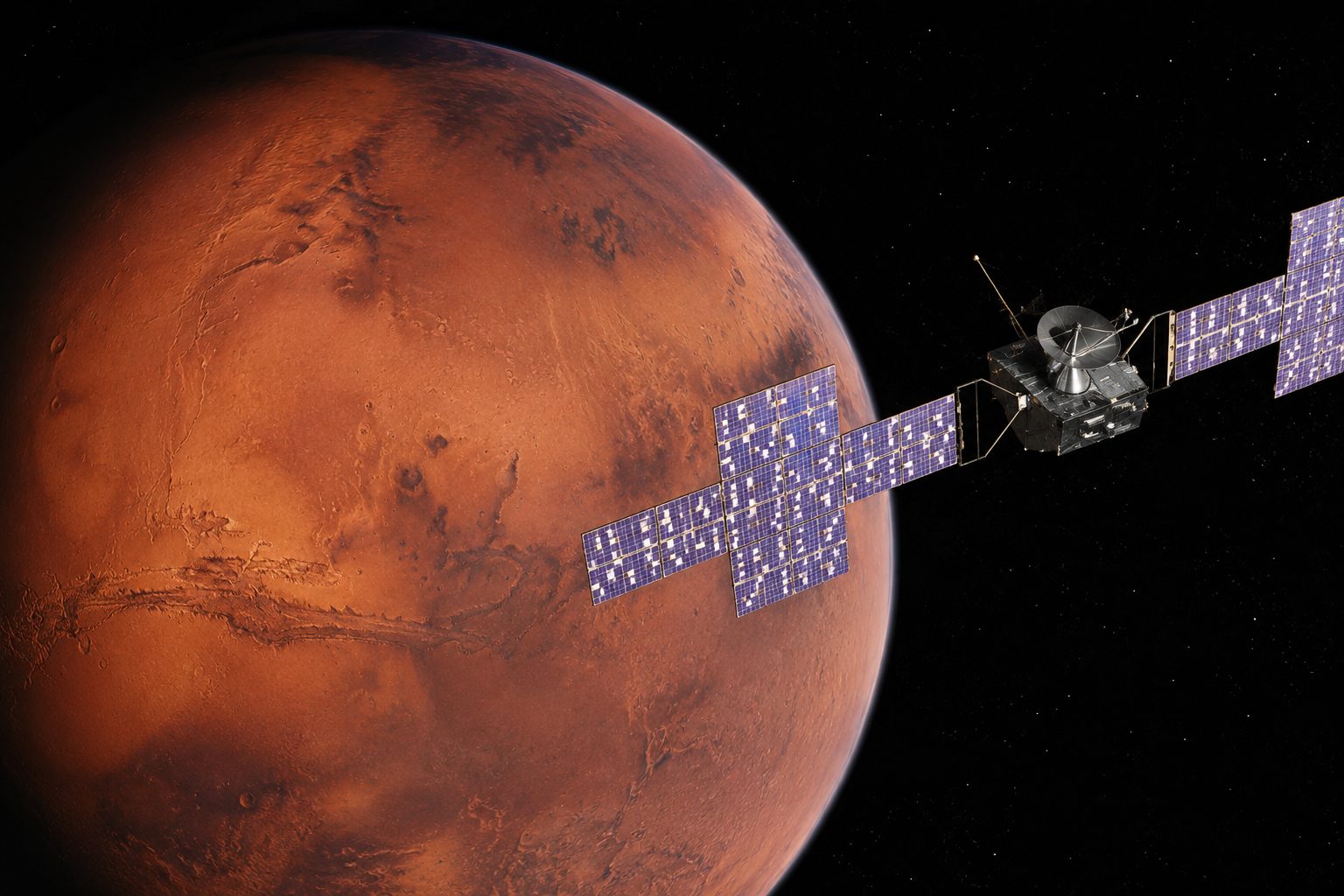
The image stands out since Psyche’s mission isn’t focused on Mars. The spacecraft swung by, leveraging Martian gravity for a speed boost and trajectory shift—no need to tap into its own propellant. For the team, the flyby doubled as a live test for cameras and instruments ahead of Psyche’s arrival at its metal-rich namesake asteroid.
NASA reported that Psyche passed just 2,864 miles (4,609 km) from Mars on May 15. Don Han, who heads navigation for Psyche at NASA’s Jet Propulsion Laboratory, said the close approach provided a 1,000 mph speed increase, putting the spacecraft “on course for arrival” by summer 2029. NASA
Psyche’s multispectral imager snapped the Huygens view around 1:18 p.m. PDT on May 15, using its array of filters to capture subtle shifts in light. In the shot, the double-ring crater—about 290 miles (470 kilometers) across—sits near 15 degrees south, surrounded by the pockmarked terrain of Mars’ southern highlands. Colors in the image likely trace out contrasts in dust, sand, and exposed bedrock.
NASA put together the image using enhanced color—red, green, and blue channels mixed to highlight features invisible to the naked eye. Each pixel in the shot covers roughly 2,200 feet, or 670 meters.
Psyche returned more images of Mars during its flyby, among them wind streaks close to Syrtis Major. NASA described these streaks as stretching around 30 miles, or 50 km, and said they likely took shape when winds swept across ancient impact craters.
Engineers used the flyby as a practice run, not just a chance for snapshots. “Thousands of images” came in, according to Jim Bell, who heads up Psyche’s imaging work at Arizona State University. NASA noted calibration shots of Mars will keep coming through the rest of the month, with the planet now pulling away. NASA
This effort is part of a crowded Mars roster. According to NASA, the Perseverance rover, Mars Reconnaissance Orbiter, and ESA’s ExoMars Trace Gas Orbiter all contributed—offering up imaging, navigation assistance, or atmospheric readings as Psyche made its flyby.
Asteroid Psyche, sitting in the main belt between Mars and Jupiter, is still the big target. NASA notes scientists suspect it could be the exposed core of a planetesimal—a piece of a would-be planet. If that’s accurate, it might reveal clues about what lies inside rocky worlds like Earth.
Psyche lifted off back on Oct. 13, 2023. If everything holds to plan, NASA’s mission page notes that the spacecraft will slip into the asteroid’s gravitational grip late in July 2029. Then, the main science work kicks off in August—about two years of mapping, imaging, and analyzing its composition lies ahead.
The Mars shots haven’t put the main science debate to rest. There’s still a lengthy cruise phase, plus orbit insertion and plenty of instrument work left for the spacecraft. Even NASA’s wording allows for a twist: if the asteroid turns out not to be the stripped-down core researchers are betting on, the outcome could shift.
Arizona State University heads up Psyche, with JPL handling mission management, systems engineering, and operations. Lindy Elkins-Tanton, principal investigator for the mission at the University of California, Berkeley, described Mars’ involvement as a “critical gravitational slingshot.” NASA