
Pasadena, California, May 29, 2026, 14:03 PDT
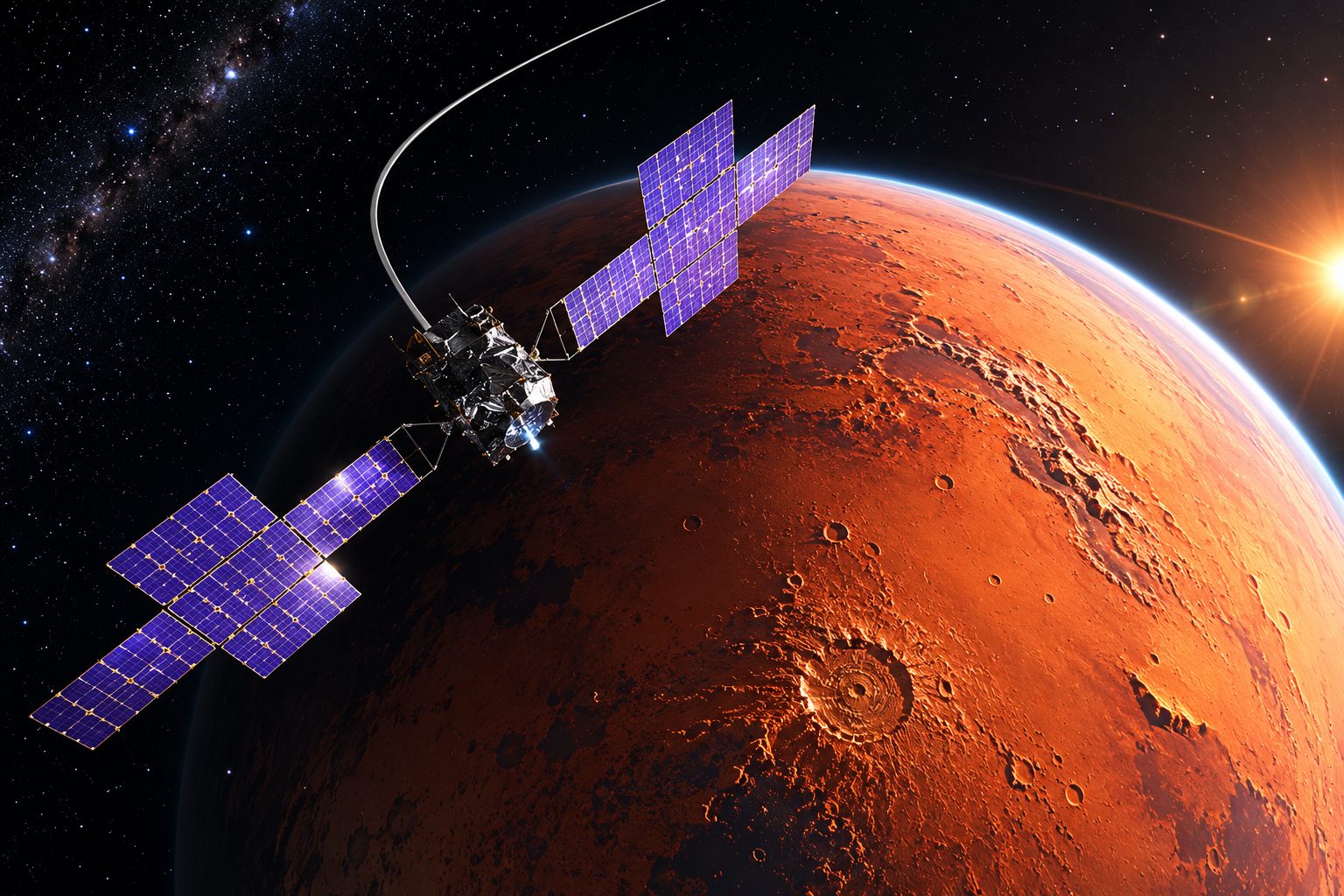
NASA’s Psyche probe snapped an enhanced-color shot of Mars’ Huygens Crater as it swung by the planet, a quick detour before heading for its primary target—a metal-rich asteroid, due in 2029. The image wasn’t the mission’s focus; that would be the trajectory tweak.
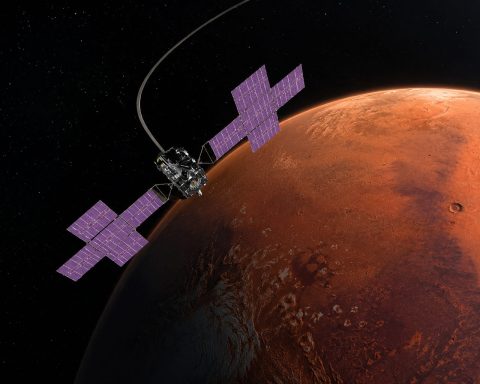
Psyche isn’t headed to Mars, so the flyby stands out. NASA pointed out that the spacecraft relied on a gravity assist—using Mars’ pull to alter its trajectory and speed, no extra propellant required—to go further out into the solar system.
Psyche made its close approach to Mars on May 15, coming within 2,864 miles (4,609 km), according to NASA. The spacecraft’s trajectory got a check via radio signals picked up by the Deep Space Network, which NASA uses to communicate with far-flung missions. Don Han, who handles navigation for Psyche at Jet Propulsion Laboratory, put it simply after the team verified a 1,000 mile-per-hour speed increase: “We are now on course.” NASA
A fresh Huygens image just out features a sprawling double-ring crater stretching some 290 miles (470 km) across, with battered southern highlands close by. NASA pointed out that the shifting colors likely point to differences in dust, sand, and exposed bedrock on this ancient slice of Martian ground.
Psyche’s multispectral imager snapped this shot of Mars using a range of color filters. According to NASA’s photojournal, the image was captured on May 15 at roughly 1:18 p.m. PDT and tweaked in enhanced color—so those hues go beyond what the eye can see, highlighting extra detail.
Jim Bell, who heads up the imaging instrument at Arizona State University, said the spacecraft snapped thousands of photos of Mars—shots that’ll be key for calibrating cameras and trialing early image-processing tools ahead of Psyche’s arrival at its asteroid destination. The team expects to continue imaging Mars for the rest of May as the planet moves farther away.
Psyche’s swing by Mars offered up fresh comparison data, stacking its findings against inputs from other spacecraft already at the red planet. NASA pointed to Perseverance, the Mars Reconnaissance Orbiter, and also the European Space Agency’s Mars Express—each feeding in surface, atmospheric, or navigation observations during the flyby.
Several instruments got the green light as well. According to NASA, the spacecraft’s magnetometers might have picked up signs of Mars’ bow shock—the spot where solar wind slams into the planet. Meanwhile, its gamma-ray and neutron spectrometer logged calibration data, lining it up with Mars readings from years past.
Psyche is set to switch back to solar-electric propulsion soon, firing up its ion engines that draw power from its solar panels as it travels toward the asteroid belt between Mars and Jupiter. According to NASA, the spacecraft should get caught by asteroid Psyche’s gravity in late July 2029. Full science operations are slated to kick off in August.
There’s a real possibility Psyche won’t deliver the pristine look at a planetary core researchers want. NASA itself puts a big question up front: maybe Psyche isn’t a core, but just unmelted rock. Until the spacecraft gets there and takes those direct readings, the mission’s main scientific reward is still up in the air.
Even if the data turns out to be inconclusive, this remains a rare mission. NASA describes Psyche as its maiden voyage targeting an asteroid dominated by metal rather than rock or ice. Plans call for the spacecraft to spend roughly two years circling the object, mapping and analyzing its makeup.
Lindy Elkins-Tanton, principal investigator for Psyche at the University of California, Berkeley, said the spacecraft picked up a crucial boost from Mars’ gravity. She wrapped up with a brief cheer: “Onward to the asteroid Psyche!” NASA