
Pasadena, California, May 23, 2026, 08:04 (PDT)
- NASA says Psyche’s May 15 Mars flyby put the spacecraft on course for a 2029 arrival at a metal-rich asteroid.
- The maneuver gave the probe a 1,000 mph speed boost and changed its orbital plane without using onboard propellant.
- Images taken during the pass will help calibrate cameras and other instruments before the spacecraft reaches its target.
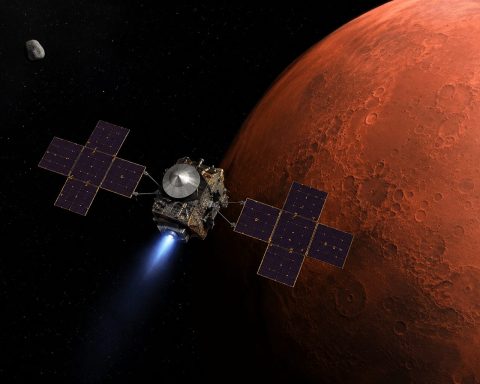
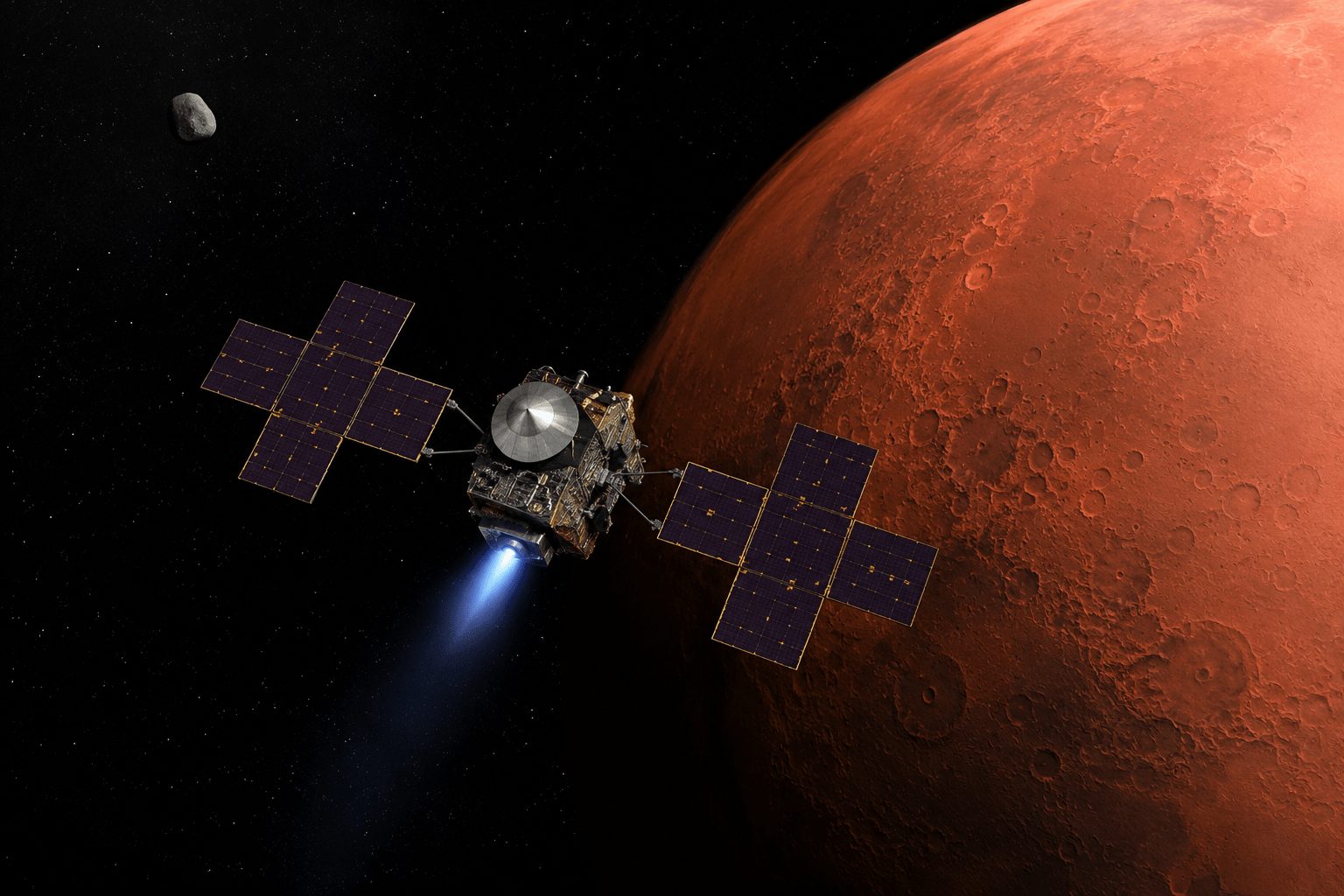
NASA’s Psyche spacecraft has completed a close flyby of Mars, using the planet’s gravity to speed up and steer itself toward a metal-rich asteroid that scientists hope will shed light on how rocky planets formed. The probe passed within 2,864 miles, or 4,609 kilometers, of the Martian surface on May 15, NASA said.
The moment matters because Psyche is no longer just cruising. The spacecraft has cleared one of the main navigation steps on a six-year trip to asteroid Psyche, a body in the main asteroid belt between Mars and Jupiter that may be the exposed core of an early planetary building block.
The Mars pass also gave mission controllers a live test of the spacecraft’s science gear. In plain terms, a gravity assist is a planetary slingshot: a spacecraft uses a planet’s motion and gravity to change speed or direction while saving fuel. NASA said the flyby adjusted Psyche’s orbital plane and sent it toward its asteroid target without burning onboard propellant.
Don Han, Psyche’s navigation lead at NASA’s Jet Propulsion Laboratory, said radio tracking through NASA’s Deep Space Network confirmed the spacecraft received “a 1,000 mile-per-hour boost” and shifted its orbital plane by about 1 degree relative to the sun. “We are now on course for arrival at the asteroid Psyche in summer 2029,” Han said. NASA
The spacecraft also took thousands of images of Mars as it moved from the planet’s night side to daylight, including a crescent view, the water ice-rich south polar cap, wind streaks in the Syrtis Major region and an enhanced-color view of Huygens crater. NASA said the crescent looked brighter and stretched farther around the planet than expected because dust in the Martian atmosphere scattered sunlight.
Jim Bell, the Psyche imager instrument lead at Arizona State University, said the Mars dataset would help calibrate the cameras and test image-processing tools being built for asteroid operations. Bell said the team would keep taking calibration images of Mars through the rest of the month as the planet recedes.
The flyby also turned on the rest of Psyche’s instrument suite, including magnetometers and gamma-ray and neutron spectrometers. NASA said early magnetometer measurements may have detected Mars’ bow shock, the boundary where the solar wind piles up as it meets a planet’s magnetic and atmospheric environment.
Psyche’s competitive set is small but notable. NASA’s Lucy mission is flying to Jupiter’s Trojan asteroids, while OSIRIS-REx returned samples from Bennu to Earth in 2023; Psyche differs by aiming to orbit a metal-rich asteroid for an extended study rather than make flybys or bring material home.
The risk is that the asteroid may not tell the clean story scientists hope for. NASA describes Psyche as a possible partial core of a planetesimal, an early planetary building block; if that reading proves wrong, the mission could still produce important data, but the payoff may be a more complicated account of how the object formed.
With Mars now behind it, Psyche is expected to resume using solar-electric propulsion for the long run to the asteroid belt. Lindy Elkins-Tanton, the mission’s principal investigator, said the team had been waiting for the flyby for years and called the Mars encounter a “critical gravitational slingshot” farther into the solar system. NASA