
PASADENA, California, May 26, 2026, 16:02 (PDT)
NASA’s Psyche probe has swung past Mars and picked up a 1,000 mph boost, tweaking its trajectory by about a degree as it heads for a metal-heavy asteroid in the main belt. On May 15, the spacecraft skimmed just 2,864 miles (4,609 km) from the red planet. Engineers later verified its new course using radio signals collected by NASA’s Deep Space Network—the sprawling antenna setup used to track missions across the solar system.
The timing was key: this flyby doubled as a navigation marker and a shakedown cruise. NASA powered up Psyche’s cameras, magnetometers, plus its gamma-ray and neutron spectrometers during the pass, calibrating with Mars—a familiar target—before these instruments are put to work on an asteroid no spacecraft has ever approached.
Psyche stands out among asteroids, NASA notes. Stretching roughly 173 miles (280 km) at its broadest, it’s thought to be a mix of rock and metal—metal making up somewhere between 30% and 60% by volume. The big question: could Psyche be the exposed core of a planetesimal, an early planetary building block?
Don Han, who leads navigation for Psyche at NASA’s Jet Propulsion Laboratory, said teams have verified the spacecraft remains “on course for arrival” by summer 2029. After the Mars gravity assist — slinging past the planet to adjust speed and trajectory without extra fuel — Psyche is now headed out toward the asteroid belt. Sky at Night Magazine
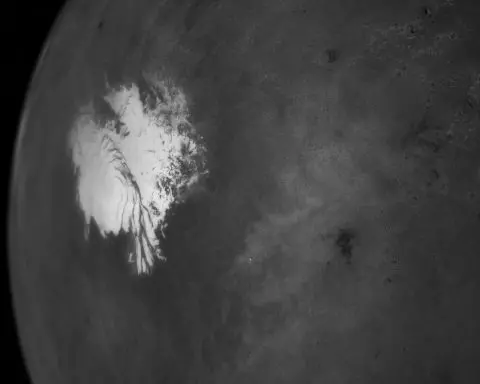
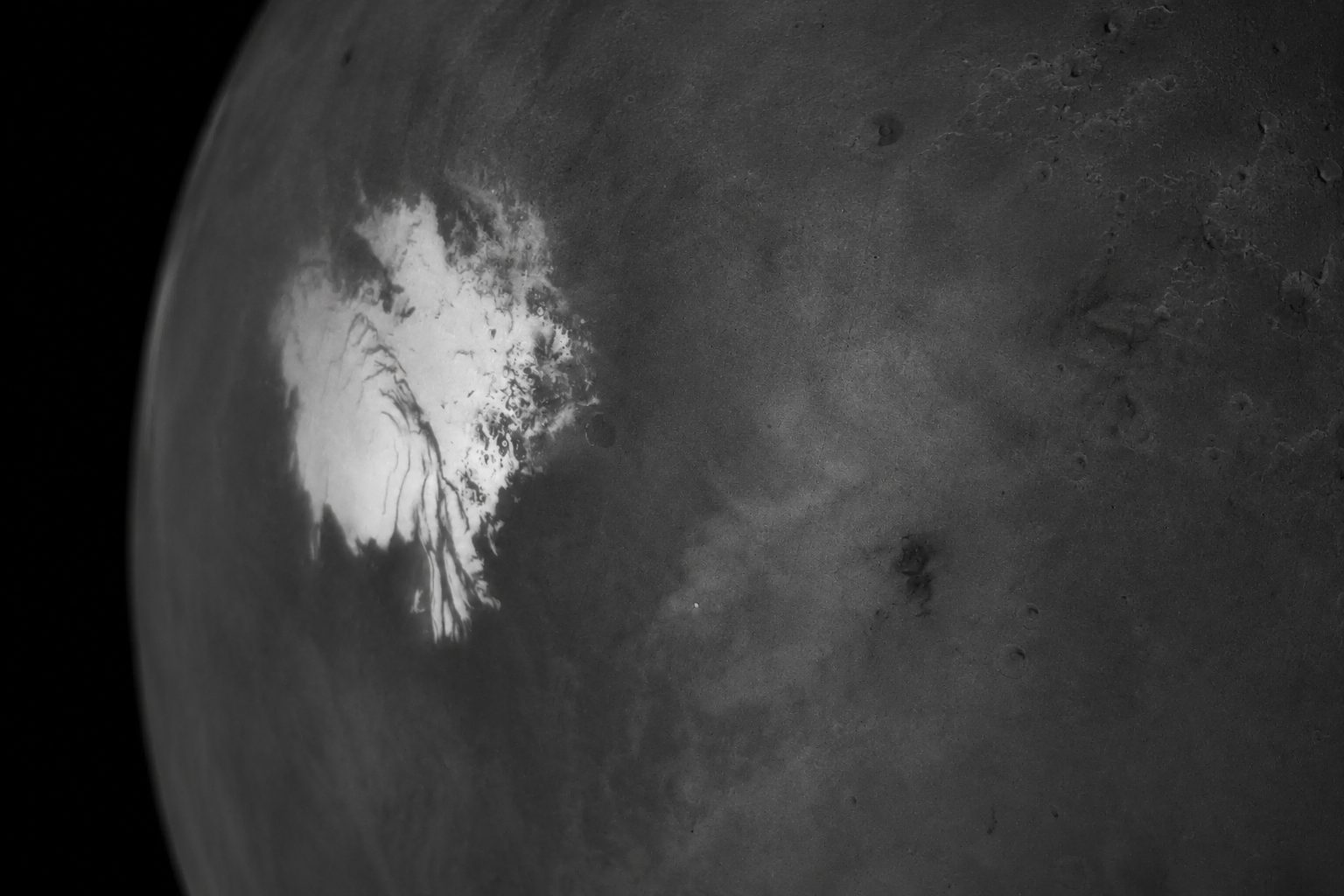
NASA picked up a fresh batch of Mars data during the flyby. Psyche’s cameras captured a slender crescent of Mars just before the craft’s closest pass, along with wind streaks over Syrtis Major and a clear view of the planet’s south polar cap, rich in water ice. Jim Bell, who leads the imaging team at Arizona State University, called the haul “unique and important opportunities” for early image processing and camera testing. Gizmodo
Psyche didn’t go it solo. Engineers leaned on data from NASA’s Perseverance rover, the Mars Reconnaissance Orbiter, and ESA’s Mars Express for a baseline—these familiar Mars platforms let them cross-check Psyche’s readings against established instruments.
David Williams, a planetary scientist at Arizona State University and Psyche’s deputy imager lead, called the flyby a chance to see “the full gamut of Mars geology.” The team also took the opportunity to test their ability to spot small satellites or dust circling a planet—a dry run for similar searches they’ll conduct around the asteroid Psyche. Scientific American
Still, the flyby leaves the top execution risk in place. Psyche only got back to running all its thrusters in June 2025, thanks to engineers shifting over to a backup propellant line. The mission had already blown past its original 2022 launch window, with NASA blaming unfinished flight-software tests. Any fresh snag with propulsion or navigation could squeeze the 2029 timeline even further.
Instead of relying on a big chemical burn, the spacecraft relies on solar-electric propulsion—ionizing xenon gas and generating a gentle but persistent thrust. Onboard, the science suite packs a multispectral imager for visible and near-infrared wavelengths, a magnetometer aimed at detecting traces of any old magnetic field, plus tools for analyzing composition and gravity.
Psyche blasted off in October 2023 for its 2.2 billion-mile journey. After reaching the asteroid, it’s set to spend about 26 months in orbit, mapping gravity, magnetism, and what’s on the surface. “Critical gravitational slingshot,” is how Lindy Elkins-Tanton, who leads the mission, described the Mars flyby. The probe now settles in for a lengthy cruise. Reuters