
PASADENA, California, May 27, 2026, 04:04 PDT
- NASA’s Psyche probe has completed its gravity assist at Mars and now heads toward asteroid Psyche, targeting arrival in 2029.
- Mission teams got a live workout for their cameras and other gear during the flyby, ahead of the main science campaign.
- This mission slots into the broader contest to investigate asteroids—potential clues to how planets began, and possible keys for defending Earth.
Psyche, NASA’s spacecraft, picked up speed and changed course using Mars as a gravity assist, notching an important navigation milestone. The six-year trek now continues toward a metal-rich asteroid, one of the solar system’s odder objects.
NASA reported that on May 15, the spacecraft swept just 2,864 miles (4,609 km) from Mars, picking up a 1,000 mile-per-hour speed boost thanks to the planet’s gravity—no need to tap into its own propellant. Afterward, NASA’s Deep Space Network tracked the probe and confirmed it’s still lined up for asteroid Psyche, out in the main belt between Mars and Jupiter.
This matters at this stage: Psyche had just one major planetary assist lined up before reaching its destination—the Mars flyby. Gravity assists, or slingshots as they’re sometimes called, let a spacecraft pick up speed and shift course using a planet’s gravity and motion. That’s fuel saved, fuel that would’ve gone into engine burns instead.
Don Han, who heads up navigation for Psyche at NASA’s Jet Propulsion Laboratory, said the spacecraft remains “on course” for its planned arrival in summer 2029. Late July that year, the asteroid’s gravity should pull Psyche into orbit, setting up the prime mission to start in August. NASA Science
There was more to the flyby than just navigation numbers. As Psyche swung past Mars, its cameras, magnetometers, and gamma-ray and neutron spectrometer all came online, letting scientists treat the red planet as a practice run. The idea: test the instruments on a familiar world before heading for an asteroid no spacecraft has previously visited.
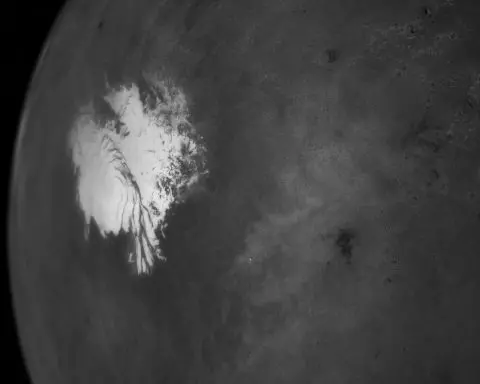
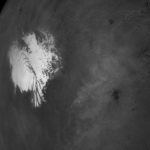
Jim Bell, who heads the Psyche imager instrument work at Arizona State University, said the group snapped thousands of pictures—material that’s expected to “calibrate and characterize” the cameras. Among the images: thin crescent shots of Mars, craters marked by wind in Syrtis Major, and a sharp, detailed view of the south polar ice cap. WIRED
Psyche snapped pictures of both the Huygens crater area and the battered southern highlands. According to NASA, the flyby’s color images were taken with the spacecraft’s multispectral imager. That instrument shoots through multiple filters, picking out variations in surface material.
The asteroid in question—Psyche—spans roughly 173 miles across at its widest, according to NASA, and could be anywhere from 30% to 60% metal by volume. There’s speculation among scientists that Psyche holds remnants from the core of a planetesimal, essentially the leftover building blocks of early planets. Still, NASA notes the object’s composition and appearance remain anyone’s guess until the spacecraft gets there.
That’s the risk baked in here. Psyche might not turn out to be an exposed planetary core after all. Newer findings point to a possible blend of rock and metal. The probe, for now, has a long journey ahead—any hiccup with its instruments or propulsion before 2029 could crimp the scientific payoff.
Psyche isn’t alone in the asteroid game. NASA’s Lucy mission is working its way through flybys of 11 targets, Jupiter Trojans among them. OSIRIS-APEX, for its part, lines up to examine asteroid Apophis after it brushes past Earth in 2029. ESA’s Hera, meanwhile, swung past Mars in 2025 en route to Didymos-Dimorphos, where it’s set to evaluate the aftermath of NASA’s DART collision.
Mars was just a pit stop for Psyche. With the flyby behind it, the spacecraft switches back to solar-electric propulsion—drawing power from its solar panels to push charged xenon gas, inching forward. Now it’s a long haul: roughly three years remain before it reaches the asteroid.