
Pasadena, California, May 27, 2026, 13:07 PDT
- NASA’s Psyche probe took advantage of Mars for its single scheduled gravity assist, tacking on roughly 1,000 mph and tilting its orbital plane about 1 degree.
- The latest Huygens Crater photo from the probe isn’t just a Mars snapshot—it doubles as a systems check. The team’s getting cameras and gear ready ahead of the 2029 asteroid rendezvous.
- Uncertainty still hangs over the asteroid: scientists haven’t pinned down if Psyche is an exposed planetary core or just a more typical mix of rock and metal.
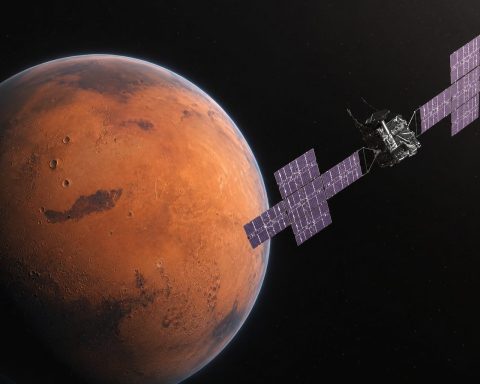
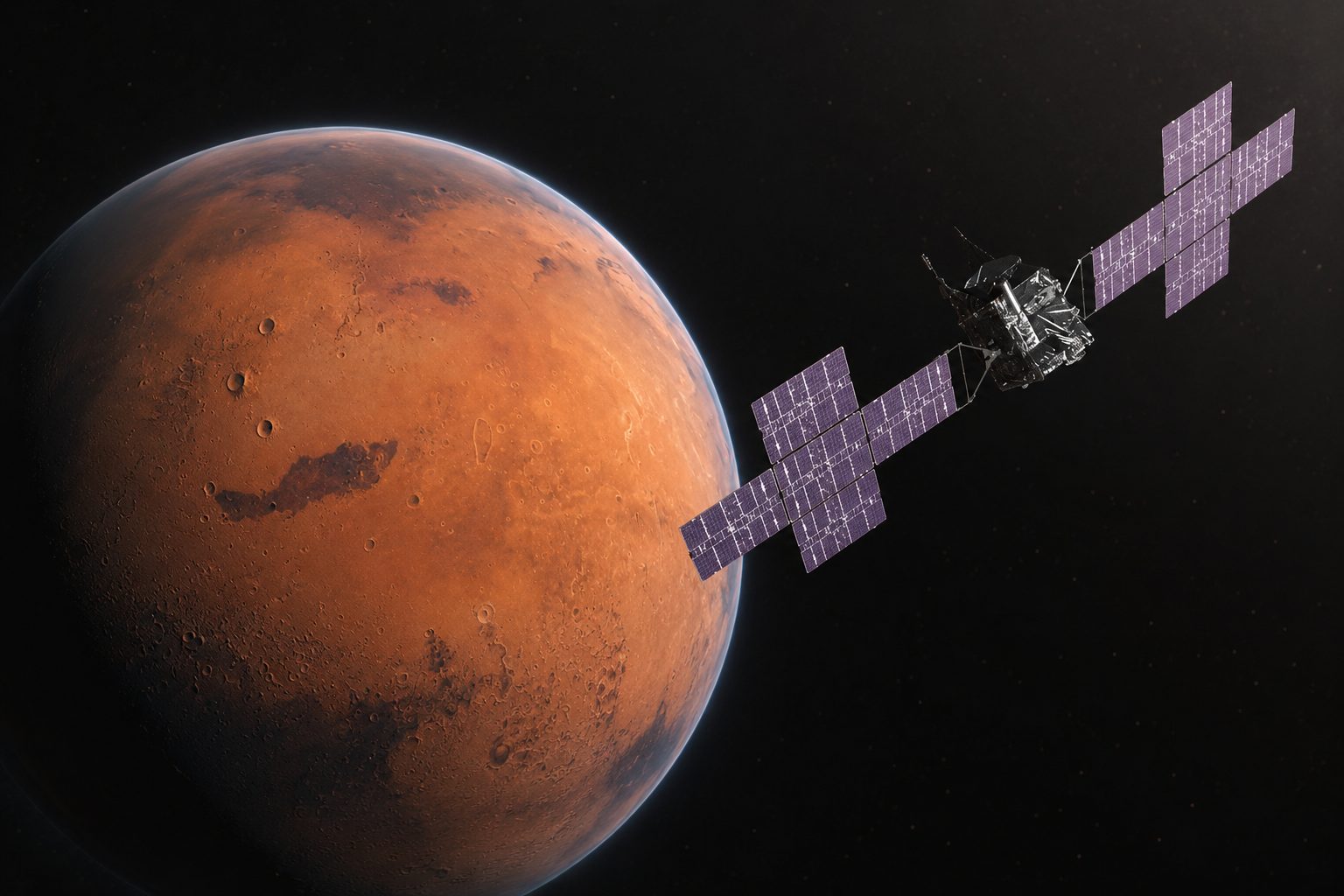
NASA’s Psyche probe snapped an enhanced-color image of Mars’ Huygens Crater just after its recent flyby, agency officials and project partners said. The shot highlights the double-ringed structure and the battered southern highlands. With the maneuver behind it, Psyche is now set for its 2029 encounter with a metal-rich asteroid.
The schedule was critical here: this Mars flyby served as Psyche’s key mid-course maneuver. On May 15, the spacecraft swept just 2,864 miles (4,609 km) above Mars, picking up speed and altering its trajectory with a gravity assist—no extra propellant needed.
This was just a rehearsal. NASA activated the spacecraft’s cameras, magnetometers, plus its gamma-ray and neutron spectrometer, putting them through their paces by focusing on a familiar planet—a way to vet the gear before it takes on an uncharted asteroid. Jim Bell, who heads up imaging for Psyche at Arizona State University, described the incoming data as “unique and important opportunities” for calibrating the cameras. NASA
Imager A snapped the Huygens shot around 1:18 p.m. PDT on May 15, shortly after Psyche’s Mars flyby. NASA pegged the image scale at about 2,200 feet (670 meters) per pixel, with the team using enhanced color — stretching the red, green, and blue filter data so color contrasts pop well beyond normal vision.
Huygens spans roughly 290 miles (470 km) and sits just south of the Martian equator at 15 degrees latitude. According to NASA info shared by Phys.org, the colors in this view probably show shifting patches of dust, sand, and ancient bedrock on Mars’ older surfaces.
Mars appeared as a slim crescent in several flyby images, with the south polar cap and streaky Syrtis Major landscapes coming through. Then, as the spacecraft traveled farther, it caught a more recognizable gibbous Mars, according to a Tuesday report from Sky & Telescope.
NASA’s Deep Space Network—the agency’s worldwide array of radio antennas for reaching far-off spacecraft—picked up the flyby. Don Han, the navigation chief for Psyche at NASA’s Jet Propulsion Laboratory, said the project remains “on course for arrival” in summer 2029 following the maneuver. NASA
Psyche blasted off in October 2023, targeting the asteroid Psyche in the main belt between Mars and Jupiter. NASA expects the spacecraft to start its survey of the asteroid by August 2029, planning roughly two years to chart the surface and gather data on composition, gravity, and magnetic field.
This mission fits into a larger Mars-and-asteroid agenda, though its quarry stands out. NASA’s Mars Reconnaissance Orbiter, the Perseverance rover, and ESA’s Mars Express all delivered reference data for the flyby. But Psyche’s focus is distinct: it’s the first time a spacecraft has targeted an asteroid believed to be packed with metal, not mainly rock or ice.
But there’s a hitch. The flyby only checks off navigation and confirms that the spacecraft’s instruments are working—it doesn’t settle whether asteroid Psyche is what scientists think. NASA has pointed to new data hinting Psyche could be part metal, part silicate, like the materials in glass or sand, with metal possibly making up anywhere from 30% to 60% of its overall volume. Still, nobody knows for sure what it actually looks like until the spacecraft gets a close look.
That uncertainty? It’s exactly what the mission is after. A 2022 review in Space Science Reviews pointed out that Psyche might be packed with core metal, could still hold onto silicate mantle, or maybe it’s a jumble of rock and metal—leaving those answers up to the spacecraft’s instruments to untangle from several formation theories.
The spacecraft has passed a key milestone following a propulsion issue. Back in 2025, NASA reported engineers switched Psyche over to its backup xenon propellant line because of a pressure drop, but later confirmed full thruster operations were back online. Arrival? Still scheduled for August 2029.