

Pasadena, California, June 5, 2026, 15:02 (PDT)
- NASA’s JPL flagged three minor asteroids set to pass close by on June 5, just weeks after 2026 JH2 zipped well inside the moon’s orbit.
- No risk from the earlier bus-sized asteroid, but its last-minute discovery underscores just how tough it is to catch small near-Earth objects.
- Data from JPL and ESA indicate several more close approaches lined up this month—a larger “potentially hazardous” asteroid is slated for June 27.
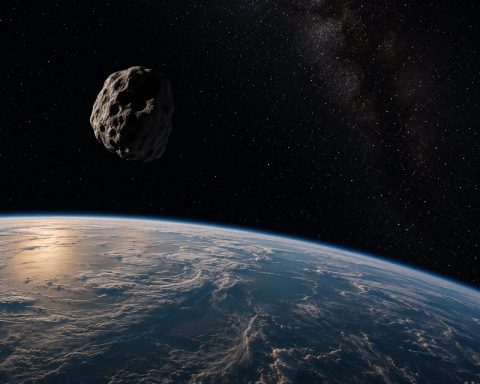
NASA’s Jet Propulsion Laboratory flagged three small asteroids set to zip past Earth on Friday, maintaining its focus on tracking near-Earth objects. Last month, 2026 JH2—a bus-sized asteroid—crossed inside the moon’s orbit with scant notice to the public.
Right now, the risk stays low. According to JPL’s Asteroid Watch dashboard, three asteroids—2026 LC, 2026 LB, and 2026 LE—passed by on June 5, at 392,000 miles, 883,000 miles, and 956,000 miles out, respectively. 2026 LC, the nearest, measured about 64 feet—comparable to the size of a house.
These recent flybys are notable in light of 2026 JH2’s close shave—NASA’s JPL puts its size somewhere from 50 to 115 feet wide, and it came just 56,000 miles from Earth on May 18. For perspective, that’s far inside the moon’s 239,000-mile average distance. NASA-backed models ruled out any chance of an impact.
Near-Earth objects—asteroids or comets—travel through orbits that pass close to Earth. JPL’s Center for Near Earth Object Studies (CNEOS) monitors these, keeping tabs on known bodies, forecasting their close passes, and evaluating potential impact risks as part of NASA’s planetary defense initiative.
The issue isn’t that all small asteroids pose a threat. It’s that many slip by nearly unnoticed—dim, quick, and often detected just days before they approach. According to ABC News, 2026 JH2 was spotted only shortly ahead of its flyby, with astronomers at five sites picking it up, among them Farpoint Observatory in Kansas and Mount Lemmon Observatory in Arizona.
“This is much closer than the moon, but about twice as far as GPS satellites,” Carson Fuls, director at the Catalina Sky Survey, said to FOX ahead of the May flyby. The asteroid, he added, would remain over 100 times dimmer than what the unaided eye can pick up, even in ideal darkness—so you’d need a backyard telescope. LiveNOW
According to JPL’s dashboard, the next five close Earth approaches fall within 4.6 million miles—7.5 million kilometers. NASA tags anything bigger than roughly 460 feet (140 meters) coming that close as a potentially hazardous object. That’s a technical term; it doesn’t signal an impact is on the table.
The European Space Agency’s Near-Earth Object Coordination Centre updated its close-approach list at 18:41 UTC on June 5, according to the tracker. The log puts 2026 LC at a distance of 631,015 km and 2026 LB at 1.42 million km on Friday—both making the list, with additional June approaches also noted.
On June 27, asteroid 152637 1997 NC1—a notably large one on the ESA calendar—is expected to pass roughly 2.57 million km from Earth, or 6.68 times the distance to the Moon. The Virtual Telescope Project pegs its size between 0.7 and 1.6 km. Despite the close approach, the encounter is considered safe.
Here’s the risk breakdown: orbits sharpen with additional observations, early figures often change. JPL notes that an object’s orbit gets recalculated using all available data, accuracy tightening as measurements come in. Its Scout system, meanwhile, checks fresh detections for any immediate risk of impact.
NASA’s working to narrow that gap. The NEO Surveyor mission—an infrared space telescope in the works—is designed to spot elusive asteroids and comets, especially the dark ones that slip past visible-light searches. Launch is on the books for late 2027.
NASA says the goal with NEO Surveyor is pretty simple: spot the riskiest asteroids and comets early enough to act, according to Amy Mainzer, the project’s survey director and a UCLA professor. It’s not just about tracking the usual harmless flybys—the real point is to catch the rare outlier that could pose a threat.