
PASADENA, California, June 5, 2026, 13:03 PDT
- NASA’s Psyche spacecraft picked up a 1,000 mph push from Mars, now heading for its meeting with an asteroid in 2029.
- While putting its cameras and instruments through their paces, the probe captured detailed shots of Mars—Huygens crater among them.
- The result comes as NASA’s Mars program deals with the loss of MAVEN, the long-serving orbiter and data relay spacecraft.
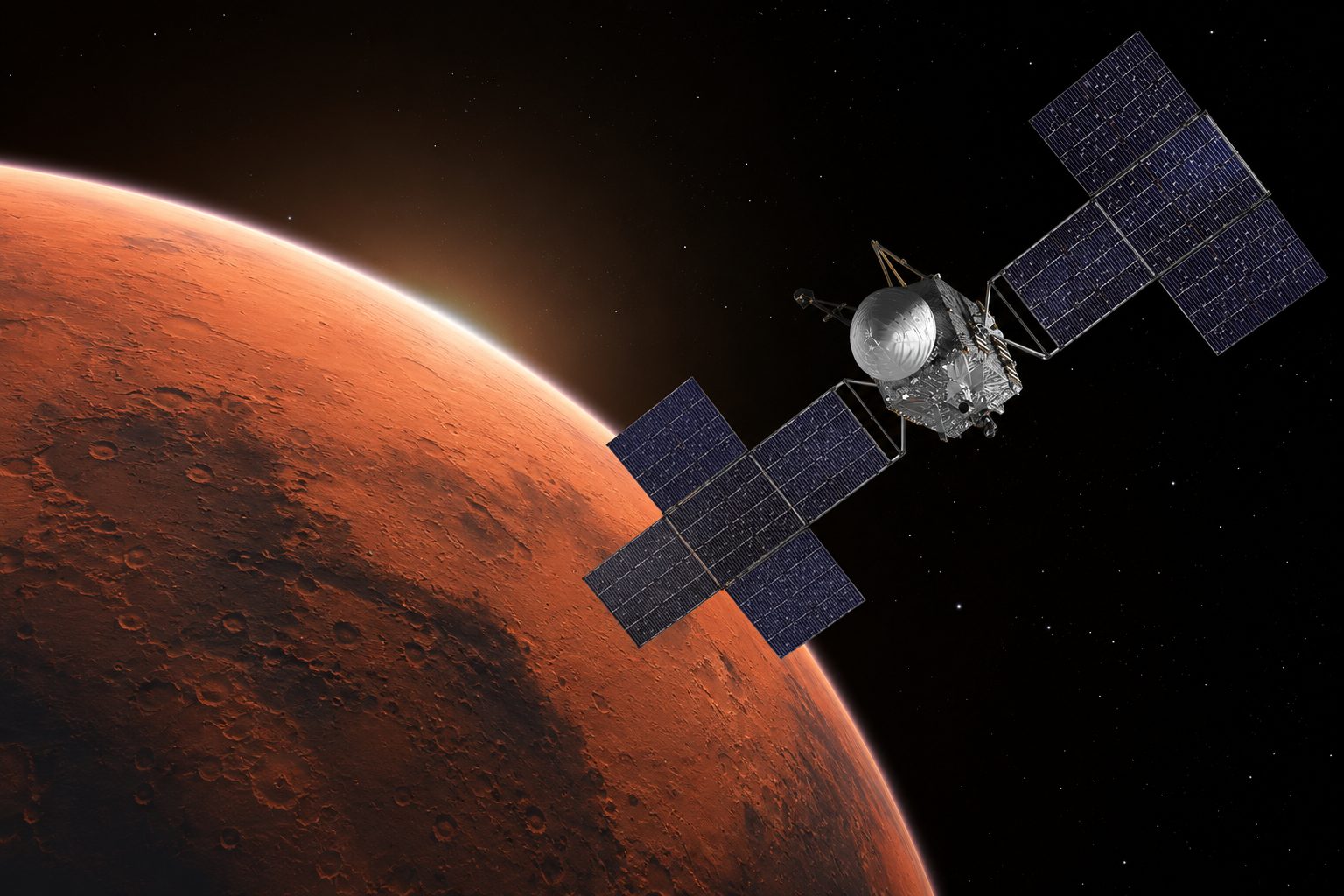
NASA said its Psyche spacecraft, on course for an asteroid packed with metal, got the boost it needed from a Mars flyby in May and is now set for a 2029 arrival.
The flyby wasn’t just about steering; it gave mission teams a chance to put Psyche’s cameras and other gear through their paces, using a familiar planet as a target before the spacecraft heads out to an unvisited asteroid. This comes as NASA’s broader Mars efforts contend with the recent, confirmed loss of its MAVEN orbiter.
Psyche swung just 2,864 miles—4,609 kilometers—past Mars on May 15, picking up speed with a gravity assist instead of burning fuel. The maneuver let Mars’ gravity nudge the spacecraft’s path, giving it an extra 1,000 mph and tilting its orbit by about a degree, according to Don Han, Psyche’s navigation lead at NASA’s Jet Propulsion Laboratory. “We are now on course,” Han said, aiming for a summer 2029 arrival. NASA
The processed image captured Huygens—a double-ring crater stretching roughly 290 miles (470 km) across—along with the battered southern highlands nearby. Each pixel in the shot covers about 2,200 feet (670 metres). According to NASA materials cited by Phys.org, the color variations probably map out shifts in dust, sand, and exposed bedrock on this ancient landscape.
At around 5:03 a.m. PDT on May 15, a different image showed Mars as a slim crescent—the final full-planet shot before Psyche’s camera view overflowed. That crescent appeared unusually bright, the arc reaching wider than anticipated, thanks to sunlight scattering in Mars’ dust-heavy atmosphere.
Psyche’s multispectral imager snapped the pictures, using a setup that captures scenes through various light filters. Jim Bell, who heads up the imager at Arizona State University, said the haul of Mars images gave their team “unique and important opportunities” to fine-tune the cameras and run checks on the image-processing tools, all in preparation for the main asteroid mission. NASA Jet Propulsion Laboratory (JPL)
NASA’s Mars Reconnaissance Orbiter, Mars Odyssey, and the ESA’s ExoMars Trace Gas Orbiter pitched in with data checks during the flyby, each supplying a mix of surface, navigation, and atmospheric readings. Before the encounter, Sarah Bairstow—who leads mission planning for Psyche at JPL—said the spacecraft was “exactly on target.” NASA Science
Launched on Oct. 13, 2023, Psyche is headed for its namesake asteroid out in the main belt between Mars and Jupiter. NASA expects Psyche’s gravity assist to lock the spacecraft into orbit by late July 2029. From there, the probe gets about two years to map the asteroid’s surface and collect information about its makeup.
This mission isn’t about mining; its focus is planetary science. Researchers believe the asteroid could hold significant amounts of iron and nickel, possibly left over from the exposed core of a planetesimal—one of those early building blocks of planets. Since Earth’s core remains off-limits to direct study, the Psyche mission represents a rare shot at observing material that might mirror what’s deep inside rocky worlds.
This week has been a tough one for NASA’s Mars efforts. On June 3, the agency announced that MAVEN—the Mars Atmosphere and Volatile Evolution spacecraft—was officially done after more than 11 years orbiting Mars. Contact was lost on Dec. 6, 2025, and after a full review, NASA’s board concluded MAVEN couldn’t be recovered or used for science or data relay. The investigation into exactly what went wrong is still underway.
Space missions tend to remember their scars, and Psyche’s is no exception. The probe has cleared its Mars flyby, but now faces a three-year journey ahead before it even reaches the asteroid. Whether Psyche’s target holds the answers scientists hope for remains uncertain until they get that close-up look. On the Mars relay side, NASA says the network is still functioning despite changes after MAVEN, though some procedures have been tweaked.
Psyche’s Mars flyby delivered what the mission team wanted: a clearer route out, some fresh instrument readings off an actual planet, and rare Mars shots snapped from an unusual vantage. Now comes a slower, steadier challenge—maintaining the probe’s systems as it heads toward its asteroid target.