
PASADENA, California, May 27, 2026, 16:03 PDT
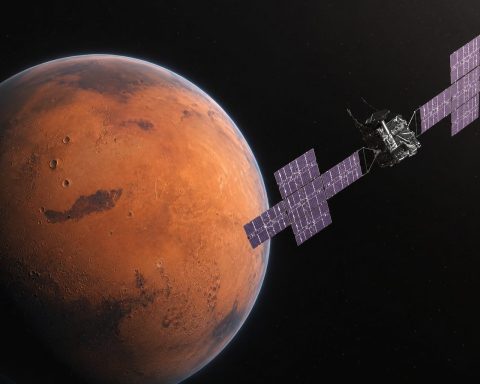
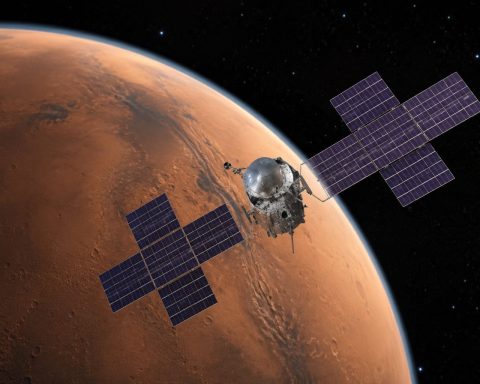
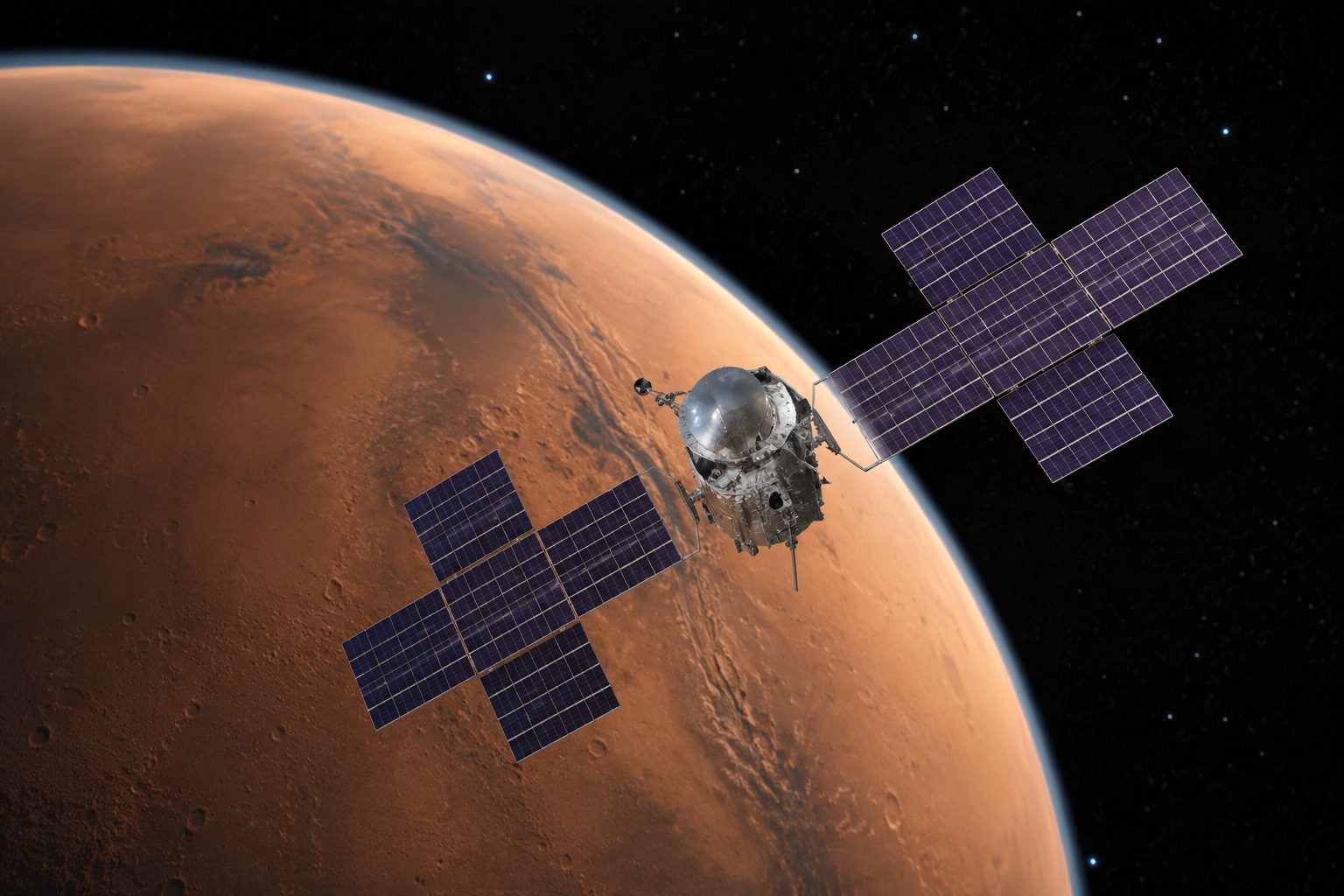
- After completing its one and only gravity-assist maneuver past Mars, NASA’s Psyche spacecraft transmitted thousands of images of the Red Planet.
- The May 15 flyby sped the probe up by roughly 1,000 mph, redirecting its course toward asteroid Psyche.
- These images serve as early tests for both the cameras and data systems, ahead of the spacecraft’s planned arrival at its destination in 2029.
During a rapid Mars flyby, NASA’s Psyche spacecraft snapped thousands of images, offering engineers a fresh batch of Red Planet shots while giving the probe’s instruments an early workout ahead of a crucial asteroid rendezvous in 2029. Teams are still poring over the encounter’s data, Sky & Telescope said Tuesday. Principal investigator Lindy Elkins-Tanton summed it up: “The team is very pleased!” Sky Telescope
The May 15 flyby wasn’t just about snapping photos. NASA confirmed that Psyche skimmed just 2,864 miles (4,609 kilometers) from Mars, relying on a gravity assist to tweak its speed and trajectory—no extra fuel required. Don Han, navigation lead at NASA’s Jet Propulsion Laboratory, said after picking up a 1,000 mile-per-hour nudge from Mars, the spacecraft remains “on course for arrival” at asteroid Psyche in summer 2029. NASA
A widely circulated image from May 15, snapped at 5:03 a.m. PDT, caught Mars as a slim crescent—right before the planet became too big to fit inside the camera’s frame. NASA noted the crescent showed up brighter and wrapped farther around the planet than scientists had expected, thanks to sunlight scattering in Mars’ dusty air. The shot combines red, green, and blue readings from Psyche’s multispectral imager, a camera that captures several wavelengths.
Coming in at a high phase angle, Psyche had an odd vantage on Mars—just a thin crescent of the planet gleamed from the spacecraft’s view. Elkins-Tanton described it to Scientific American as “a really beautiful moment” to test out the instruments. For David Williams, planetary scientist at Arizona State University and deputy imager lead, the pass promised a look at “the full gamut of Mars geology.” Scientific American
NASA reported that the flyby captured images of Huygens—a double-ring crater spanning roughly 290 miles—the rugged southern highlands, and Mars’ massive water-ice-filled south polar cap, stretching more than 430 miles wide. Jim Bell, the imager lead for Psyche at Arizona State University, called the new set of data “unique and important opportunities” for putting their camera system and image-processing tools through their paces ahead of the main asteroid mission. NASA
The Psyche spacecraft did more than just snap photos on its Mars flyby. NASA switched on the probe’s magnetometers—those are magnetic-field sensors—and its gamma-ray and neutron spectrometer, tools designed to give clues about what’s inside. NASA’s raw-image archive is uploading shots from the lead-up, the close pass, and beyond, capturing Mars shifting from a slim crescent to a massive disc before shrinking again.
The real competition here is scientific rather than commercial. Psyche’s brief scan of Mars offers a chance to line up its findings with the extensive datasets collected by NASA’s Mars Reconnaissance Orbiter, as well as ESA’s Mars Express and ExoMars Trace Gas Orbiter—spacecraft that have been watching the planet for years. That overlap gives Psyche’s team a direct way to pit their one-shot measurements against trusted Mars records.
Asteroid Psyche is still the primary objective—a metallic world sitting in the main belt between Mars and Jupiter. As Reuters noted before the flyby, the spacecraft was sent up in October 2023 for a 2.2 billion-mile journey, with plans to spend 26 months in orbit around Psyche, studying gravity, magnetic fields and the surface makeup.
No guarantees the mission goes by the book. Scientists suspect asteroid Psyche could be the stripped core of a planetesimal—essentially, the remains of an early planet. Still, as Reuters pointed out, that’s just the top theory for now. The story isn’t settled. Sky & Telescope, for its part, noted there’s been no confirmation yet on whether the flyby’s moon hunt spotted Phobos or Deimos.
Mars handled its role this time. NASA said the spacecraft is set to fire up its solar-electric engines again, plotting a course for the asteroid belt. Once there, it’ll circle Psyche in multiple orbits to map the surface. After the maneuver, Elkins-Tanton summed it up: “Onward to the asteroid Psyche!” NASA