

Pasadena, California, May 25, 2026, 08:10 PDT
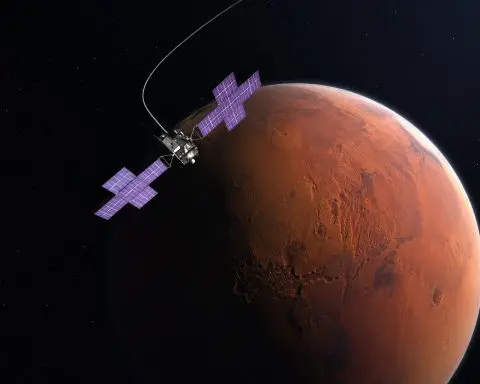
- After a close pass by Mars, NASA’s Psyche spacecraft is officially headed for a 2029 rendezvous with the metal-heavy asteroid Psyche.
- Picking up about 1,000 mph, the probe’s May 15 flyby shaved fuel use by tapping into a gravitational assist.
- Scientists picked up thousands of Mars images and instrument readings from the flyby, a haul they’ll use to fine-tune the spacecraft ahead of its primary mission.
NASA says its Psyche probe is now on a straight path to the Psyche asteroid, following a critical Mars flyby. The spacecraft swung just 2,864 miles (4,609 km) from the red planet on May 15, picking up speed and changing its orbital tilt—no propellant needed, just gravity. That maneuver also locked in a key navigation milestone for the six-year journey.
Timing is key here: this flyby wasn’t just a detour. NASA had folded it directly into Psyche’s 2.2 billion-mile course, aiming to save xenon fuel for the solar-electric ion thrusters—the propulsion system that uses electricity to expel charged gas, gradually accelerating the spacecraft.
Mars became a handy test subject as well. NASA fired up Psyche’s cameras, magnetometers, and gamma-ray and neutron spectrometer, running the instruments through their paces on familiar ground before they confront an asteroid that’s never been imaged from this close.
Don Han, who heads navigation for Psyche at NASA’s Jet Propulsion Laboratory in Southern California, said data from the Deep Space Network confirmed Mars slingshotted the probe, increasing its speed by 1,000 miles per hour and tilting its orbital plane about 1 degree with respect to the sun. NASA’s Deep Space Network—a worldwide web of radio antennas—tracked the maneuver.
These aren’t just standard publicity shots. Psyche captured a slim Mars crescent, then a nearly full face of the planet after its closest pass, plus the bright water-ice south polar cap. Wind streaks crossing impact craters in Syrtis Major, and an enhanced-color look at Huygens crater’s double rings, round out the set.
Jim Bell, who leads the Psyche imager team at Arizona State University, called the Mars data “unique and important opportunities” for calibrating the cameras and trying out image-processing tools ahead of the asteroid phase. According to Bell, the team plans to keep collecting images of Mars for the remainder of May, as the planet drifts farther away. Gizmodo
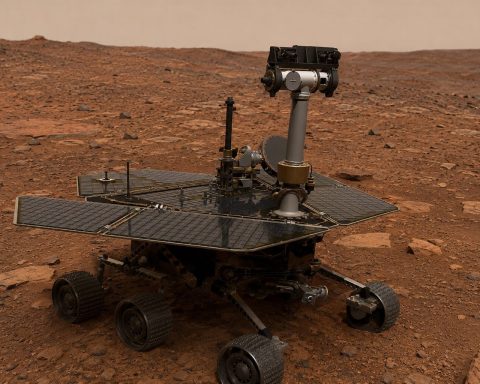
Peer spacecraft at Mars lent a hand with the calibration. NASA pointed to Perseverance, Curiosity, Mars Reconnaissance Orbiter, and 2001 Mars Odyssey, plus the European Space Agency’s Mars Express and ExoMars Trace Gas Orbiter, as sources for comparison observations and navigation data during the flyby.
Launched back in October 2023, Psyche is on track for an August 2029 rendezvous with its target asteroid. Measuring roughly 173 miles wide, the asteroid sits in the main belt between Mars and Jupiter. Scientists think it could be the exposed core of a planetesimal—the kind of early planetary building block that never quite turned into a full-fledged planet.
That central idea is still just a hypothesis. Should Psyche prove less like a bare planetary core than scientists suspect, the mission will still deliver detailed maps of gravity, magnetism, and composition—though the science narrative might pivot away from “inside a planet” toward a blend of metal, rock, and old impacts. NASA
Lindy Elkins-Tanton, principal investigator for the mission at the University of California, Berkeley, said the team had been looking forward to the Mars flyby for years, calling the Red Planet’s gravity a “critical gravitational slingshot.” Now, the spacecraft gets set to switch back to solar-electric propulsion as it continues its journey toward the asteroid belt. NASA