
New York, June 8, 2026, 18:02 EDT
- Orders for SpaceX’s $75 billion share sale have stacked up to around $150 billion, putting the offering at about twice oversubscribed.
- This deal would gauge just how much appetite investors have for a company being sold these days as an artificial intelligence infrastructure play—not just rockets and Starlink.
- Goldman Sachs is taking a leading spot on the syndicate, joined by Morgan Stanley and JPMorgan.
Investors have put in roughly $150 billion in orders for SpaceX’s blockbuster IPO, which is offering $75 billion in stock—Barron’s said Monday. That’s double what’s available, signaling plenty of appetite, though the frenzy isn’t quite at the top tier of recent IPOs. “Oversubscribed” here means buyers want more shares than what’s actually up for grabs. Barron’s
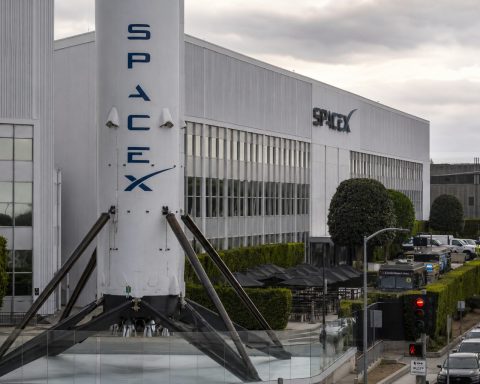
Timing is key here. Elon Musk’s rocket and satellite group is pushing to price what could be the biggest IPO on record this week, letting public investors tap into Starlink, launch operations, and its upstart AI unit—all at a roughly $1.75 trillion valuation. According to Reuters, SpaceX has set sights on a June 12 Nasdaq debut, trading under the ticker SPCX.
The offering arrives just as big tech IPOs hit the market. According to Reuters, AI players Anthropic and OpenAI are lining up to raise cash from public investors, setting up SpaceX as a key gauge for how much appetite remains for high-growth AI-linked names.
According to a European prospectus dated June 5, SpaceX is planning to price shares at $135 for its U.S. offering, targeting roughly $74.4 billion in net proceeds if all base shares are taken up. That figure could climb to about $85.7 billion if underwriters pick up their option for extra stock. The company has earmarked the funds for AI compute infrastructure, launch vehicles, and launch infrastructure. AI compute refers to the data-center muscle needed for training and running AI models.
Barron’s had already reported back in May that Goldman Sachs was set for a top spot. Now, the prospectus confirms it: Goldman lines up as a joint lead book-runner alongside Morgan Stanley, Bank of America, Citigroup, and JPMorgan. Altogether, the underwriting team projects they’ll collect about $500 million in total discounts and commissions.
SpaceX is leaning further into retail distribution than what’s typical for megadeals. According to the prospectus, a portion of shares should reach U.S. retail investors via Charles Schwab, Fidelity, Robinhood, SoFi, and E*Trade. Meanwhile, Investopedia points out: if SPCX gets a quick entry into major benchmarks post-listing, index funds could be obligated to buy.
That might give early trading a lift, but there’s a flip side. “Whenever it’s known that there’s a major addition to an index, there’s always a run-up in price,” said Elisabeth Kashner, director of global funds research at FactSet, in a comment to Investopedia. The surge comes as traders move in ahead of anticipated index-fund buying. Investopedia
Opinions are sharply divided on the AI story. Dan Ives, who leads tech research at Wedbush Securities, labeled SpaceX “the largest IPO in stock market history,” arguing the company is right in the sweet spot for two major growth themes. On the other hand, Dennis Dick, a proprietary trader with Triple D Trading, told Reuters the prospect is “a little scary”—especially when you’re talking about a roughly $2 trillion valuation pinned on hopes it will “reach the stars.” Reuters
The risk side jumps out: SpaceX pulled in $4.69 billion in Q1 revenue but still posted a net loss of $4.28 billion, a sharp jump from its $528 million loss a year ago, as R&D spending more than doubled. Investor Steve Eisman told CNBC—per Business Insider—that “the entire company is being bet on AI,” not space or Starlink. SpaceX Business Insider
SpaceX’s operating outlook continues to hinge on execution. On Monday, Reuters highlighted President Gwynne Shotwell’s pivotal role—she’s been at SpaceX since 2002, securing those crucial early launch contracts and landing the 2008 NASA resupply agreement that stabilized the company after the Falcon 1 setbacks. Former SpaceX exec Jim Cantrell called her “a bridge between what Elon wanted and what could be done.” Reuters
In the coming days, watch whether the order book picks up speed or just sits at an adequate level. Should demand stall out at two times covered, underwriters might still push the deal through. That said, the kind of first-day “pop” investors hope for in a marquee IPO? Far from guaranteed then.